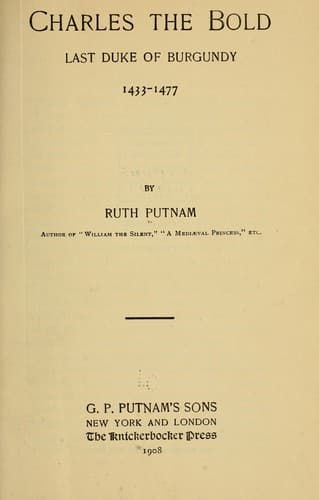
Charles the Bold, Last Duke of Burgundy, 1433-1477Putnam, Ruth
History
Charles the Bold, Last Duke of Burgundy, 1433-1477
Putnam, Ruth
Burgundy (France) -- History; Charles, Duke of Burgundy, 1433-1477; Switzerland -- History -- 1032-1499
Mulhouse was seriously affected by these lawless depredations. To her,
Berne promised aid in a twenty-five years' alliance signed in 1466,
and at Berne's insistance the cowardly nobles restrained their
license. But when the city attempted to extend its authority Sigismund
interfered. Having no army, however, he could not recover Waldshut,
which the Swiss claimed a right to annex, except by offering ten
thousand florins for the town's ransom. Poor in cash as he was in men,
he had, however, no means to pay this ransom and begged aid in every
direction. Moreover, he feared further aggressions from the cantons,
which were growing more daring. What man in Europe was better able to
teach them a lesson than Charles, the destroyer of Liege, the stern
curber of undue liberty in Flanders? Was he not the very person to
tame insolent Swiss cowherds?
In the course of the year 1468, Sigismund made known to Charles his
desire for a bargain, intimating that in case of the duke's refusal,
he would carry his wares to Louis XI. At that moment, Charles was
busied with Liege and showed no interest in Sigismund's proposition.
The latter tried to see Louis XI. personally in accordance with his
imperial cousin's advice that an interview might be more effective
than a letter.
It did not prove a propitious time, however; Louis was deeply engaged
with Burgundy and he was not disposed to take any steps that might
estrange the Swiss--and any espousal of Sigismund's interests might
alienate them. He did not even permit an opening to be made, but
stopped Sigismund's approach to him by a message that he would not for
a moment entertain a suggestion inimical to those dear friends of his
in the cantons--a sentiment that quickly found its way to Switzerland.
Thus stayed in his effort to win Louis's ear, Sigismund decided that
he would make another essay towards a Burgundian alliance, this time
face to face with the duke. On to Flanders he journeyed and found
Charles in the midst of the ostentatious magnificence already
described. Ordinary affairs of life were conducted with a splendour
hardly attained by the emperor in the most pompous functions of his
court. Sigismund was absolutely dazzled by the evidence of easy
prosperity. The fact that a maiden was the duke's sole heiress led
the Austrian to conceive the not unnatural idea that this attractive
Burgundian wealth might be turned into the impoverished imperial
coffers by a marriage between Mary of Burgundy and Maximilian, the
emperor's son.
[Illustration: MARY OF BURGUNDY FROM CONTEMPORANEOUS MINIATURE
REPRODUCED IN BARANTE, "LES DUCS DE BOURGOGNE"]
Public-domain text, read in full here on John Shaqi.
Reviews
Reviews
No reviews yet
Be the first to share your thoughts on this work.
Elsewhere in the archive
Join the Discussion
Join the discussion
Sign in to leave a comment or review.
Sign InorCreate an account