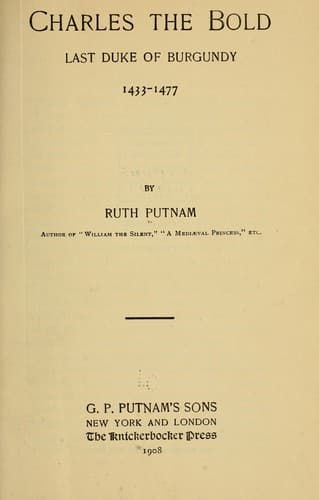
Charles the Bold, Last Duke of Burgundy, 1433-1477Putnam, Ruth
History
Charles the Bold, Last Duke of Burgundy, 1433-1477
Putnam, Ruth
Burgundy (France) -- History; Charles, Duke of Burgundy, 1433-1477; Switzerland -- History -- 1032-1499
The visitor not only thought of this possibility, but he immediately
broached it to Charles. The bait was swallowed. As to the main
proposition which Sigismund had come expressly to make, that, too,
was not rejected. The duke perceived that the transfer of the Rhenish
lands to his jurisdiction might militate to his advantage. A passage
would be opened towards the south for his troops without the need of
demanding permission from any reluctant neighbour. The risk of trouble
with the Swiss did not affect him when weighing the advantages of
Sigismund's proffer, a proffer which he finally decided to accept.
Probably he found his guest a pleasant party to a bargain, for not
only did he broach the tempting alliance between Mary and Maximilian,
but he, too, seems to have hinted that the title of "King of the
Romans" might be added to the long list of appellations already signed
by Charles.[6] As Sigismund was richer in kin, if not in coin, than
the feeble Podiebrad, Charles gave serious heed to the suggestion
which fell incidentally from his guest's lips, in the course of the
long conversations held at Bruges.
Certain precautions were taken to protect Charles from being dragged
into Swiss complications against his will, and then in May, 1469,
the treaty of St. Omer was signed,[7] wherein the Duke of Burgundy
accorded his protection to Sigismund of Austria and received from him
all his seigniorial rights within certain specified territories.
The most important part of this cession comprised Upper Alsace and
the county of Ferrette, but there were also many other fragments of
territory and rights of seigniory involved, besides lordship over
various Rhenish cities, such as Rheinfelden, Saeckingen, Lauffenburg,
Waldshut and Brisac. This last named town commanded the route
eastward, as Waldshut that to the southeast, and Thann the highway
through the Vosges region.
Fifty thousand florins was the price for the property and the claims
transferred from Sigismund to Charles. Ten thousand were to be paid at
once, in order to ransom Waldshut from the Swiss. The remainder was
due on September 24th. On his part, Sigismund specifically recognised
the duke's right to redeem all domains nominally his but mortgaged for
the time being, certain estates or seignorial rights having been thus
alienated for 150 years.
Public-domain text, read in full here on John Shaqi.
Reviews
Reviews
No reviews yet
Be the first to share your thoughts on this work.
Elsewhere in the archive
Join the Discussion
Join the discussion
Sign in to leave a comment or review.
Sign InorCreate an account