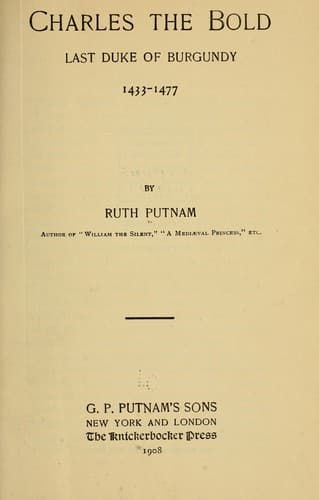
Charles the Bold, Last Duke of Burgundy, 1433-1477Putnam, Ruth
History
Charles the Bold, Last Duke of Burgundy, 1433-1477
Putnam, Ruth
Burgundy (France) -- History; Charles, Duke of Burgundy, 1433-1477; Switzerland -- History -- 1032-1499
This territorial transfer was not a sale. It was a mortgage, but a
mortgage with possession to the mortgagee and further restricted by
the provision that there could be no redemption unless the mortgager
could repay at Besançon the whole loan plus all the outlay made by the
mortgagee up to that date. Instalment payments were expressly ruled
out. The entire sum intact was made obligatory. Therefore the danger
of speedy redemption did not disquiet Charles. He knew the man he had
to deal with. Sigismund's lack of foresight and his prodigality were
notorious. There was faint chance that he could ever command the
amount in question. Accordingly, Charles was fairly justified in
counting the mortgaged territory as annexed to Burgundy in perpetuity.
Sigismund pocketed his florins eagerly. Nothing could have been more
welcome to him. But this relief from the pressure of his pecuniary
embarrassment did not inspire him with love for the man who held his
lost lands. His sentiments towards Charles were very similar to those
of an heir towards a usurer who has helped him in a temporary strait
by mulcting him of his natural rights.
As for the emperor, when this transfer of territory was an
accomplished fact, he began to take fright at the consequences. He did
not like this intrusion of a powerful French peer into the imperial
circle.[8] At the same time he was ready to make him share
responsibility in any further difficulties that might arise between
Sigismund and the Swiss.
The least skilful of prophets could have foreseen difficulties for
Charles on his own account, both foreign and domestic. His own
relations with the Swiss had always been friendly enough, but he had
never before been so near a neighbour, while, within the Rhine lands,
it was an open question whether the bartered inhabitants were to
enjoy or regret their new tie with Burgundy. The importance of their
sentiments was a matter of as supreme indifference to Charles as was
danger from the Confederation. Neither conciliation nor diplomacy
was in his thoughts. He had no conception of the intricacies of the
situation. He counted the landgraviate as definitely his by the treaty
of St. Omer as Brabant by heritage or Liege by conquest.
The need of a kindly policy towards the little valley towns--a policy
that might have won their allegiance--never occurred to him. They were
his property and Peter von Hagenbach was, in course of time, made
lieutenant-governor in his behalf.
Public-domain text, read in full here on John Shaqi.
Reviews
Reviews
No reviews yet
Be the first to share your thoughts on this work.
Elsewhere in the archive
Join the Discussion
Join the discussion
Sign in to leave a comment or review.
Sign InorCreate an account