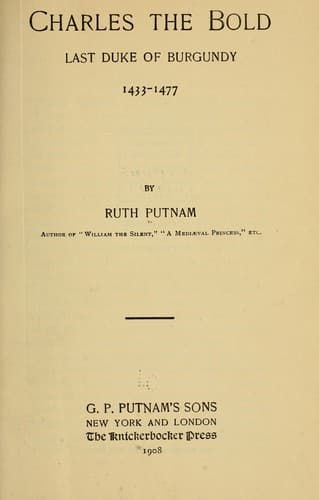
Charles the Bold, Last Duke of Burgundy, 1433-1477Putnam, Ruth
History
Charles the Bold, Last Duke of Burgundy, 1433-1477
Putnam, Ruth
Burgundy (France) -- History; Charles, Duke of Burgundy, 1433-1477; Switzerland -- History -- 1032-1499
A league from the gates, the magistrates and burghers stood in the
road awaiting the travellers from St. Omer. All were barefooted and
bareheaded. Under the December sky they waited the approach of the
stately procession. When the duke arrived, they all fell upon their
knees and implored him to forgive the late troubles and to reinstate
their city in his favour. Philip did not answer immediately--delay was
always a feature of these episodes. Thereupon, the Duke of Orleans,
both duchesses, and all the gentlemen joined their entreaties to the
citizens' prayers. Again a pause, and then, as if generously yielding
to pressure, Philip bade the burghers put on their shoes and their
hats while he accepted at their hands the keys of all the gates. Then
the long procession moved on towards Bruges. At the gate were the
clergy, followed by the monks, nuns, and beguins of the various
convents and foundations, bearing crosses, banners, reliquaries, and
many precious ecclesiastical treasures. There, too, were the gilds
and merchants, on horseback, with magnificent accoutrements freshly
burnished to do honour to the welcome they offered their forgiving
overlord.
Throughout Bruges, at convenient places, platforms and stages
were erected, whereon were enacted dramatic performances, given
continuously, to provide amusement for the collected crowds. Sometimes
the presentation carried significance beyond mere entertainment. Here
a maid, garbed as a wood nymph, appeared leading a swan which wore the
collar of the Golden Fleece and a porcupine. This last beast was to
symbolise the Orleans device, _Near and Far_, as the creature was
supposed to project his spines to a distance.
One enthusiastic citizen covered his whole house with gold and the
roof with silver leaves to betoken his satisfaction. Indeed, if we
may believe the chroniclers, never in the memory of man had any city
incurred so much expense to honour its lord. The duke permitted his
heart to be touched by these proofs of devotion, and on the very
evening of his arrival he evinced that his confidence was restored by
sending the civic keys and a gracious message to the magistrates. At
the news of this condescension the cries of "_Noël_" re-echoed afresh
through the illuminated streets.
Charles was not present at this entry, which took place on Saturday,
December 11th, but Philip was so much entertained with the performance
that he sent for his son, and on the following Saturday he and the
Countess of Charolais came from Ghent to join the party. The Duke of
Orleans and many nobles rode out of the city to meet the young couple,
who were formally escorted to the palace by magistrates and citizens
in a body. On the Sunday there were repetitions of some of the plays
and every attention was offered by the Bruges burghers to their young
guests. When Orleans departed with his bride on Tuesday, December
14th, what wonder that the lady wept in sorrow at leaving these gay
Burgundian doings!
Public-domain text, read in full here on John Shaqi.
Reviews
Reviews
No reviews yet
Be the first to share your thoughts on this work.
Join the Discussion
Join the discussion
Sign in to leave a comment or review.
Sign InorCreate an account