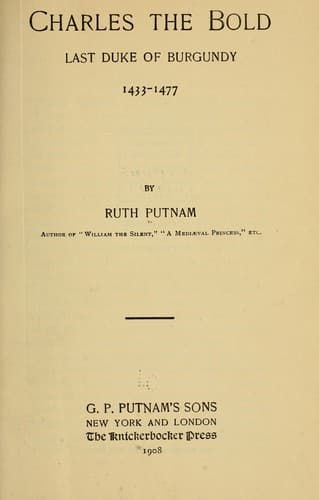
Charles the Bold, Last Duke of Burgundy, 1433-1477Putnam, Ruth
History
Charles the Bold, Last Duke of Burgundy, 1433-1477
Putnam, Ruth
Burgundy (France) -- History; Charles, Duke of Burgundy, 1433-1477; Switzerland -- History -- 1032-1499
Apart from all personal considerations of enmity and amity of natives
and neighbours, the territory of Upper Alsace and the county of
Ferrette, delivered from needy Austria to rich Burgundy, like a coat
pawned by a poor student, was held under very complex and singular
conditions.[9] The status of the bargain between Sigismund and Charles
was in point of fact something between pawn and sale, according to the
point of view. Sigismund fully intended to redeem it, while Charles
did not admit that possibility as remotely contingent. Nor was that
the only peculiarity. The itemised list of the ceded territories as
given in the treaty was far from telling the facts of the possessions
passing to Sigismund's proxy.
In the first place the Austrian seigniories were not compact. They
were scattered here and there in the midst of lands ruled by others,
as the Bishop of Strasburg, the Abbé of St. Blaise in the Black
Forest, the count Palatine, the citizens of Basel and of Mulhouse, and
others.
The existent variety in the extent and nature of Austrian title was
extraordinary. Nearly every possible combination of dismembered
prerogative and actual tenure had resulted from the long series of
ducal compositions. In some localities a toll or a quit-rent was the
sole cession, and again a toll or a prerogative was almost the only
residue remaining to the ostensible overlord, while all his former
property or transferable birthright privileges were lodged in
various hands on divers tenures. There were cases in which the
mortgagee--noble, burgher, or municipal corporation--had taken the
exact place of the Austrian duke and in so doing had become the vassal
of his debtor, stripped of all vested interest but his sovereignty.
For in these bargains wherein elements of the Roman contract and
feudal customs were curiously blended, two classes of rights had been
invariably reserved by the ducal mortgagers:
(1) Monopolies, regal in nature, such as assured free circulation on
the highways, the old Roman roads, all jurisdiction of passports and
travellers' protection.
(2) The suzerainty. This comprised the power to confer fiefs, of
requisition of military service, of requesting _aids_ and admission to
strongholds, cities, or castles, _le droit de forteresse jurable et
rendable_.
In these regards the compact between Charles and Sigismund differed
from all previous covenants not only in degree, but in kind. The Duke
of Burgundy entered into the _sovereign_ as well as into the mangled,
maimed, and curtailed proprietary rights of the hereditary over-lord.
Public-domain text, read in full here on John Shaqi.
Reviews
Reviews
No reviews yet
Be the first to share your thoughts on this work.
Elsewhere in the archive
Join the Discussion
Join the discussion
Sign in to leave a comment or review.
Sign InorCreate an account