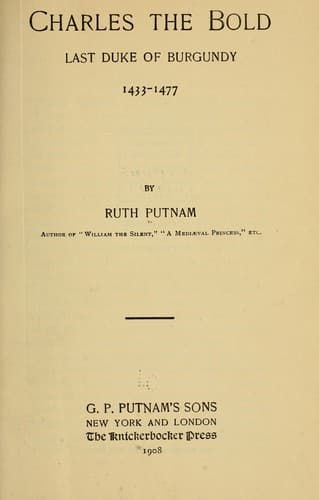
Charles the Bold, Last Duke of Burgundy, 1433-1477Putnam, Ruth
History
Charles the Bold, Last Duke of Burgundy, 1433-1477
Putnam, Ruth
Burgundy (France) -- History; Charles, Duke of Burgundy, 1433-1477; Switzerland -- History -- 1032-1499
Charles promised to go against the Turk in person, and to place
a thousand men at Frederic's disposal, so soon as all points at
issue between him and Louis XI. were settled, and provided that
his estates were erected into a kingdom, which should also
comprise the bishoprics of Liege, Utrecht, Toul, Verdun, and the
duchies of Lorraine, Savoy, and Cleves. This realm was to be
a fief of the empire like Hungary, Bohemia, and Poland, and
transmissible by heredity in the male and female line--a necessary
recognition of a woman's right, approved by both parties, for Mary
of Burgundy was to marry Maximilian.
Electoral confirmation alone was wanting, and in regard to that
there was much voluminous correspondence and much shuffling of
responsibility. The electors of Mayence and of Trèves were the
only ones present to speak for themselves, and they declared
that the matter ought to be referred to a full conclave of the
electoral college.[9] Let the candidate for royalty await the
decision of the next diet, appointed for November at Augsburg.
Never loth to delay, the emperor proposed this solution to
Charles, who replied haughtily that if his request were not
complied with he would join Louis XI. in a league hostile to the
empire. This was on November 6th. The Archbishop of Trèves then
suggested that if the question could not wait for a diet, at
least the electors should be summoned, especially the elector of
Brandenburg, whom he knew to be influential with the emperor, and
who was a leader in the anti-Burgundian and anti-Bohemian German
party. This seemed fair, but the emperor suddenly put on a show of
authority and declared, with an injured air, that he was perfectly
free to act on his own initiative without confirmation. In the
interests of Christianity and of the empire he would appoint
Charles of Burgundy chief of the crusade, and he would crown him
king.
The organised opposition to his plan came to the duke's ears and
made him very angry. Yet, at the same time, he had no desire
to dispense with electoral consent. Possibly he felt that the
imperial staff alone was too feeble to conjure his kingdom into
permanent existence. It was finally decided that Frederic III.
should display his power to the extent of investing Charles
at once with the duchy of Guelders, while the more important
investiture should be postponed.
Public-domain text, read in full here on John Shaqi.
Reviews
Reviews
No reviews yet
Be the first to share your thoughts on this work.
Elsewhere in the archive
Join the Discussion
Join the discussion
Sign in to leave a comment or review.
Sign InorCreate an account