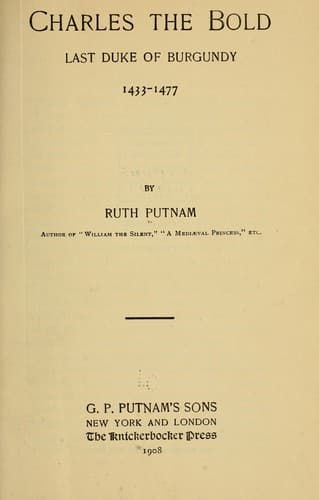
Charles the Bold, Last Duke of Burgundy, 1433-1477Putnam, Ruth
History
Charles the Bold, Last Duke of Burgundy, 1433-1477
Putnam, Ruth
Burgundy (France) -- History; Charles, Duke of Burgundy, 1433-1477; Switzerland -- History -- 1032-1499
In 1445, Ghent had been honoured by the celebration of the feast of
the Order of the Golden Fleece within her gates. Two years later,
Philip appeared in person at a meeting of the _collace_, or municipal
assembly, and delivered a harangue to the Ghentish magistrates and
burghers, flattering them, moreover, by using their vernacular. The
tenor of this speech was as follows[10]:
"My good and faithful friends, you know how I have been brought
up among you from my infancy. That is why I have always loved you
more than the inhabitants of all my other cities, and I have
proved this by acceding to all your requests. I believe then that
I am justified in hoping that you will not abandon me to-day when
I have need of your support. Doubtless you are not ignorant of the
condition of my father's treasury at the period of his death. The
majority of his possessions had been sold. His jewels were
in pawn. Nevertheless, the demands of a legitimate vengeance
compelled me to undertake a long and bloody war, during which the
defence of my fortresses and of my cities, and the pay of my
army have necessitated outlays so large that it is impossible to
estimate them. You know, too, that at the very moment when the war
on France was at its height, I was obliged, in order to assure the
protection of my country of Flanders, to take arms against the
English in Hainaut, in Zealand, and in Friesland, a proceeding
costing me more than 10,000 _saluts d'or,_ which I raised with
difficulty. Was I not equally obliged to proceed against Liege, in
behalf of my countship of Namur, which sprang from the bosom of
Flanders? It is not necessary to add to all these outlays those
which I assume daily for the cause of the Christians in Jerusalem,
and the maintenance of the Holy Sepulchre.
"It is true, however, that, yielding to the persuasions of the
pope and the Council, I have now consented to put an end to the
evils multiplied by war by forgetting my father's death, and by
reconciling myself with the king. Since the conclusion of this
treaty, I considered that while I had succeeded in preserving
to my subjects during the war the advantages of industry and of
peace, they had submitted to heavy burdens in taxes and in
voluntary contributions, and that it was my duty to re-establish
order and justice in the administration. But everything went on as
though the war had not ceased. All my frontiers have been menaced,
and I found myself obliged to make good my rights in Luxemburg, so
useful to the defence of my other lands, especially of Brabant and
Flanders.
Public-domain text, read in full here on John Shaqi.
Reviews
Reviews
No reviews yet
Be the first to share your thoughts on this work.
Join the Discussion
Join the discussion
Sign in to leave a comment or review.
Sign InorCreate an account