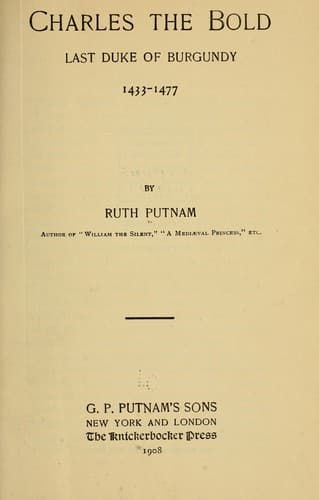
Charles the Bold, Last Duke of Burgundy, 1433-1477Putnam, Ruth
History
Charles the Bold, Last Duke of Burgundy, 1433-1477
Putnam, Ruth
Burgundy (France) -- History; Charles, Duke of Burgundy, 1433-1477; Switzerland -- History -- 1032-1499
"In this way, my expenses continued to increase; all my resources
are now exhausted, and the saddest part of it all is that the good
cities and communes of Flanders and especially the country folk
are at the very end of their sacrifices. With grief I see many of
my subjects unable to pay their taxes, and obliged to emigrate.
Nevertheless, my receipts are so scanty that I have little
advantage from them. Nor do I reap more from my hereditary lands,
for all are equally impoverished.
"A way must be found to ease the poor people, and at the same time
to protect Flanders from insult, Flanders for whose sake I would
risk my own person, although to arrive at this end, important
measures have become imperative."
After this affectionate preamble, Philip finally states that, in order
to raise the requisite revenues, no method seemed to him so good and
so simple as a tax on salt, three sous on every measure for a term of
twelve years. He promised to dispense with all other subsidies and to
make his son swear to demand nothing further as long as the _gabelle_
was imposed.
"Know [he added in conclusion] that even if you consent to it I
will renounce it if others prove of a different opinion, for I do
not desire that the communes of Flanders be more heavily weighted
than any other portion of my territory."
The duke might have spared his trouble and his elaborate
condescension. The answer to his conciliatory request was a flat
refusal to consider the matter at all. Salt was a vital necessity to
Flemish fisheries, and its cost could not be increased to the least
degree without serious inconvenience. The Flemings were wroth at his
imitating the worst custom of his French kinsmen.
Philip departed from Ghent in great dudgeon. After a time he was
persuaded that the indisposition of the town to meet his reasonable
wishes was not due to the citizens at large, but to the machinations
of a few unruly agitators among the magistrates. In 1449, therefore,
he took a high-handed course of trying to direct the issue of the
regular municipal elections, so as to ensure the choice of magistrates
on whose obedience he could rely. The appearance of Burgundian troops
in Ghent, before the election of mid-August, aroused the wrath of the
community, who thought that their most cherished franchises were in
jeopardy.
Public-domain text, read in full here on John Shaqi.
Reviews
Reviews
No reviews yet
Be the first to share your thoughts on this work.
Join the Discussion
Join the discussion
Sign in to leave a comment or review.
Sign InorCreate an account