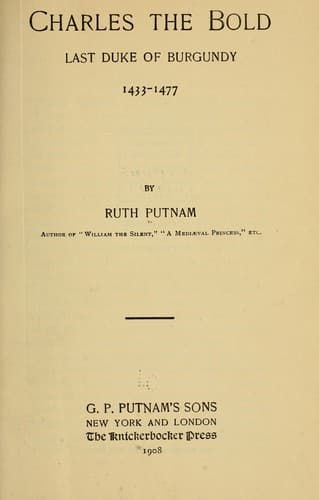
Charles the Bold, Last Duke of Burgundy, 1433-1477 — John Shaqi
Charles the Bold, Last Duke of Burgundy, 1433-1477Putnam, Ruth
History
Charles the Bold, Last Duke of Burgundy, 1433-1477
Putnam, Ruth
Burgundy (France) -- History; Charles, Duke of Burgundy, 1433-1477; Switzerland -- History -- 1032-1499
For a time various negotiations went on between Philip and envoys from
Ghent. The latter took a high hand and insinuated in unmistakable
terms that if the duke refused an accommodation with them, they would
appeal to their suzerain, the King of France. No act of rebellion,
overt or covert, exasperated Philip more than this suggestion. Charles
VII. was only too ready to ignore those clauses in the treaty of
Arras, releasing the duke from homage, and virtually acknowledging his
complete independence in his French territories. The king accepted
missives from his late vassal's city, without reprimanding the writers
for their presumption in signing themselves "Seigneurs of Ghent."[12]
His action, however, was confined to mild attempts at mediation.
It was plain to the duke that his other towns would follow Ghent's
resistance to his authority if there were hopes of her success.
Therefore he threw aside all other interests for the time being, and
exerted himself to levy a body of troops to crush Flemish pretensions.
His counsellors advised him to sound the temper of other citizens and
to ascertain whether their sympathies were with Ghent. Answers of
feeble loyalty came back to him from the majority of the other towns.
Undoubtedly they highly approved Ghent's efforts. They, too, could
not afford to pay taxes fraught with danger to their commerce, nor to
relinquish one jot of privileges dearly bought at successive crises
throughout a long period of years. The only doubt in their minds was
as to the ultimate success of the burghers to stem the course of
Burgundian usurpation. Therefore, they first hedged, and then
consented to aid the duke. This course was pursued by the Hollanders
and the Zealanders, all alike short-sighted.
The Ghenters succeeded in possessing themselves of the castle of
Poucque by force, and of the village of Gaveren by stratagem, taking
advantage in the latter case of the castellan's absence at church.
When every part of his dominions had been canvassed for troops, and
Philip was prepared for his first active campaign against Ghent, he
was anxious to leave his heir under the protection of the duchess,
conscious that the imminent contest would be bitter and deadly. A
pretence was made that the young count's accoutrements were not ready,
and that, therefore, he would have to remain in Brussels.
"But he whose ambitions waxed, hastened the completion of his
accoutrements, and swore by St. George, the greatest oath he ever
used, that he would rather go in his shirt than not accompany his
father to punish his impudent rebel subjects."[13]
The approaching hostilities were watched by foreign merchants in dread
of commercial disaster.
Public-domain text, read in full here on John Shaqi.
Reviews
Reviews
No reviews yet
Be the first to share your thoughts on this work.
Join the Discussion
Join the discussion
Sign in to leave a comment or review.
Sign InorCreate an account