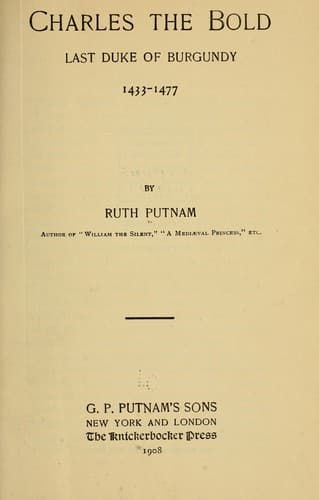
Charles the Bold, Last Duke of Burgundy, 1433-1477Putnam, Ruth
History
Charles the Bold, Last Duke of Burgundy, 1433-1477
Putnam, Ruth
Burgundy (France) -- History; Charles, Duke of Burgundy, 1433-1477; Switzerland -- History -- 1032-1499
This was the beginning of a bitter struggle between Ghent and Philip.
The duke found it no light matter to coerce the independent burghers
into remembering that they were simply part of the Burgundian state.
"_Tantæ molis erat liberam gentem in servitutem adigere_!" ejaculates
Meyer in the midst of his chronicle of the details of fourteen months
of active hostilities.[11] Matters were long in coming to an outbreak.
Various points had been contended over, when Philip had endeavoured
to change the seat of the great council, or to take divers measures
tending to concentrate certain judicial or legislative functions for
his own convenience, but in a manner prejudicial to the autonomy of
Ghent. His centripetal policy was disliked, but when his policy went
further, and he attempted to control purely civic offices, dislike
grew into resentment and the Ghenters rose in open revolt.
For a time, their opposition passed in Philip's estimation as mere
insignificant unruliness. By 1452, however, the date of the tourney
above described, it became evident that a vital issue was at stake.
The Estates of Flanders endeavoured to mediate between overlord and
town, but without success. Owing to Philip's interference in the
elections, the results were declared void, and when a new election was
appointed, the Burgundians accused the city of hastily augmenting its
number of legal voters by over-facile naturalisation laws. The gilds,
too, evinced a readiness to be very lenient in their scrutiny of
candidates for admission to their cherished privileges, preferring,
for the nonce, numbers to quality. Occupancy of furnished rooms was
declared sufficient for enfranchisement, and there were cases where
mere guests of a bourgeois were hastily recorded on the lists as
full-fledged citizens.
By these means the popular party waxed very strong numerically. The
sheriffs found themselves quite unequal to holding the rampant spirit
of democracy in check. The regular government was overthrown, and the
demagogues succeeded in electing three captains _(hooftmans)_
invested with arbitrary power for the time being. The decrees of
the ex-sheriffs were suspended, and a mass of very radical measures
promulgated and joyfully confirmed by the populace, assembled on the
Friday market. It was to be the judgment of the town meeting that
ruled, not deputed authority. One ordinance stipulated that at the
sound of the bell every burgher must hasten to the market-place, to
lend his voice to the deliberations.
Public-domain text, read in full here on John Shaqi.
Reviews
Reviews
No reviews yet
Be the first to share your thoughts on this work.
Join the Discussion
Join the discussion
Sign in to leave a comment or review.
Sign InorCreate an account