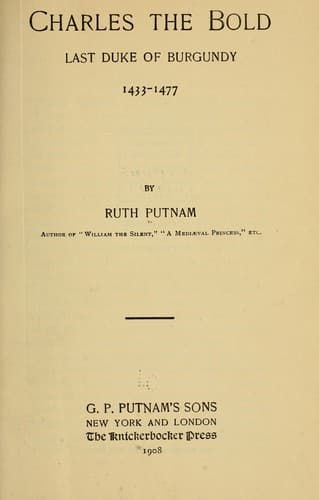
Charles the Bold, Last Duke of Burgundy, 1433-1477Putnam, Ruth
History
Charles the Bold, Last Duke of Burgundy, 1433-1477
Putnam, Ruth
Burgundy (France) -- History; Charles, Duke of Burgundy, 1433-1477; Switzerland -- History -- 1032-1499
Now it is evident, in summing up the salient features of this failure,
that a vital principle was not germinating in the inchoate mass.
Charles himself never attained the rank of a national hero. More than
that, with all his individual states, he never had any nation, great
or small, at his back. Personally he was a man without a country. His
father, Philip, was French, pure and simple, quite as French as his
grandfather, Philip the Hardy, the first Duke of Burgundy out of the
House of Valois, even though Philip the Good had extended his sway
to many non-French-speaking peoples and was able to use the Flemish
speech if it suited his whim. But that was as a condescension and as
something extraneous. The chief of French peers remained his proudest
title; his ability to influence French affairs, the task he liked
best.
His son was quite different in his attitude towards France. He
minimised his degree of French blood royal. More than once he boasted
of his kinship with Portuguese, with English stock. He had certain
characteristics of an immigrant, who has abandoned family traditions
and is proudly confident that his bequest to posterity is to outshine
what he has inherited. Charles was not exactly a stupid man, but he
certainly was dazzled by his early surroundings into an overestimate
of himself, into a conceit that was a tremendous stumbling-block in
his path. He had not the kind of intelligence that would have enabled
him to take at their worth the rhetorical phrases of adulation heaped
upon him on festal occasions. Yet this same conceit, this very
self-confidence, gave him a high conception of his duties. At his
accession, he showed a sense of his responsibilities, a definite
theory of conduct which he fully intended to act upon. His very belief
in his own powers gave him an intrinsic honesty of purpose. He was
convinced that he could maintain law, order, justice in his domain,
and he fully intended to do so in a paternal way, but he left out of
consideration the rights of the people, rights older than his dynasty.
In his military career, too, at the outset, he evinced the strongest
bent towards preserving the best conditions possible amid the
brutalities of warfare. He curbed the soldiers' passions, he protected
women, and was as relentless towards miscreants in his ranks as
towards his foe. In civil matters he exerted himself to secure
impartial equity for all alike. When he gave a promise, he fully
intended to make his words good. It was only in the face of repeated
deceptions of the cleverer and more unscrupulous Louis XI. that
Charles changed for the worse. Exasperated by the knowledge that the
king's solemn pledges were given repeatedly with no intention of
fulfilment, he attempted to adopt a similar policy and was singularly
infelicitous in his imitation. His political methods degenerated into
mere barefaced lying, softened by no graces, illumined by no clever
intuition of where to draw the line. From 1472 on, the duke's word was
Public-domain text, read in full here on John Shaqi.
Reviews
Reviews
No reviews yet
Be the first to share your thoughts on this work.
Elsewhere in the archive
Join the Discussion
Join the discussion
Sign in to leave a comment or review.
Sign InorCreate an account