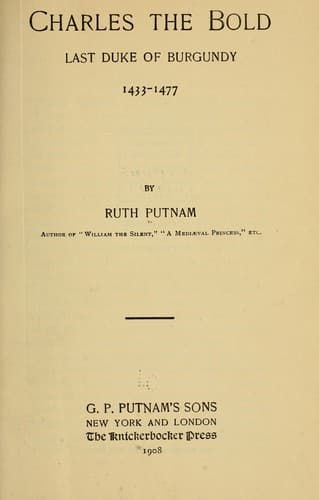
Charles the Bold, Last Duke of Burgundy, 1433-1477Putnam, Ruth
History
Charles the Bold, Last Duke of Burgundy, 1433-1477
Putnam, Ruth
Burgundy (France) -- History; Charles, Duke of Burgundy, 1433-1477; Switzerland -- History -- 1032-1499
[Footnote 17: Meyer, p. 313. La Marche, ii., 313. Lavisse, _Histoire
de France_, accepts 13,000 as the number slain. Chastellain (ii., 375)
puts the number at 22-30,000, including those drowned by the duke's
order. Du Clercq lets a certain sympathy for the rebellious people
escape his pen. Chastellain and La Marche treat the antagonism to
taxes as unreasonable.]
[Footnote 18: Chastellain, ii., 387.]
[Footnote 19: La Marche, ii., 331. The Chastellain MS. is lacking for
this event.]
[Footnote 20: _Revue des sociétés savantes des départements_, 7me.
série, 6, p. 209.
These two reports were enclosed with brief notes dated July 31 and
August 8, 1453, from the ducal attorney at Amont to the magistrates
of Baume. The former was one of the highest officials in the
Franche-Comté. The reporter might have been one of his secretaries.
The two notes with their unsigned enclosures were discovered (1881)in
the archives of the town of Baume-les-Dames.]
[Footnote 21: Kervyn, _Histoire de Flandre_, iv., 494.]
CHAPTER III
THE FEAST OF THE PHEASANT
1454
After the fatigues of this contest with Ghent, followed a period of
relaxation for the Burgundian nobles at Lille, where a notable
round of gay festivities was enjoyed by the court. Adolph of Cleves
inaugurated the series with an entertainment where, among other
things, he delighted his friends by a representation of the tale of
the miraculous swan,[1] famous in the annals of his house for bringing
the opportune knight down the Rhine to wed the forlorn heiress.
When his satisfied guests took their leave, Adolph placed a chaplet on
the head of one of the gentlemen, thus designating him to devise a new
amusement for the company; and under the invitation lurked a tacit
challenge to make the coming occasion more brilliant than the first.
Again and again was this process repeated. Entertainment followed
entertainment, all a mixture of repasts and vaudeville shows in whose
preparation the successive hosts vied with each other to attain
perfection.
The hard times, the stress of ready money, so eloquently painted when
the merchants were implored to take pity on their poverty-stricken
lord, were cast into utter oblivion. It was harvest tide for skilled
craftsmen and artisans. Any one blessed with a clever or fantastic
idea easily found a market for the product of his brain. He could see
his poetic or quaint conception presented to an applauding public with
a wealth of paraphernalia that a modern stage manager would not
scorn. How much the nobles spent can only be inferred from the ducal
accounts, which are eloquent with information about the creators of
all this mimic pomp. About six sous a day was the wage earned by a
painter, while the plumbers received eight. These latter were called
upon to coax pliable lead into all sorts of shapes, often more
grotesque than graceful.
Public-domain text, read in full here on John Shaqi.
Reviews
Reviews
No reviews yet
Be the first to share your thoughts on this work.
Join the Discussion
Join the discussion
Sign in to leave a comment or review.
Sign InorCreate an account