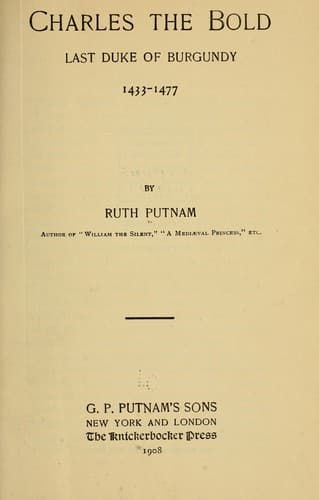
Charles the Bold, Last Duke of Burgundy, 1433-1477Putnam, Ruth
History
Charles the Bold, Last Duke of Burgundy, 1433-1477
Putnam, Ruth
Burgundy (France) -- History; Charles, Duke of Burgundy, 1433-1477; Switzerland -- History -- 1032-1499
It is said that the baby cavalier was nourished by his own mother.
Having lost her first two infants, Isabella was solicitous for the
welfare of this third child, who also proved her last. He was,
moreover, Philip's sole legal heir, as Michelle of France and Bonne of
Artois, his first wives, had left no offspring. The care and devotion
expended on the boy were repaid. Charles became a sturdy child who
developed into youthful vigour. In person, he strangely resembled
his mother and her Portuguese ancestors, rather than the English
Lancastrians, from whom she was equally descended.
His dark hair and his features were very different from the fair type
of his paternal ancestors, the vigorous branch of the Valois family.
Possibly other characteristics suggesting his Portuguese origin were
intensified by close association with his mother, who supervised the
education directed by the Seigneur d' Auxy. They often lived at The
Hague, where Isabella acted as chief and official adviser to the
duke's stadtholder in the administration. [14]
Charles was a diligent pupil, if we may believe his contemporaries,
surprisingly so, considering his early taste for all martial pursuits
and his intense interest in military operations.
At two years of age he received his first lesson in horsemanship, on
a wooden steed constructed for his especial use by Jean Rampart, a
saddler of Brussels.
His biographers repeat from each other statements of his proficiency
in Latin. This must be balanced by noting that the only texts which
he could have read were probably not classic. In the inventory of the
various Burgundian libraries of the period, there are not six Greek
and Latin classical texts all told, and excepting Sallust, not a
single Roman historian in the original.[15] There was a translation
of Livy by the Prior of St. Eloi and late abridgments of Sallust,
Suetonius, Lucan, and Cæsar,[16] with a French version of Valerius
Maximus, but nothing of Tacitus. Doubtless these versions and a volume
called _Les faits des Romains_ were used as text-books to teach the
young count about the world's conquerors. The last mentioned book
shows what travesties of Roman history were gravely read in the
fifteenth century.
Public-domain text, read in full here on John Shaqi.
Reviews
Reviews
No reviews yet
Be the first to share your thoughts on this work.
Join the Discussion
Join the discussion
Sign in to leave a comment or review.
Sign InorCreate an account