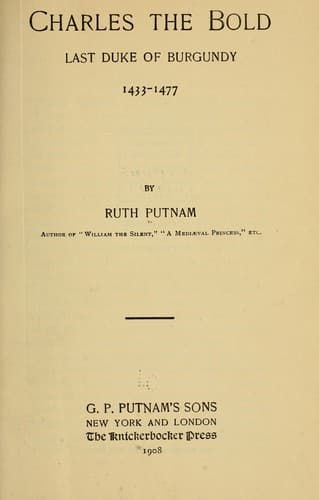
Charles the Bold, Last Duke of Burgundy, 1433-1477Putnam, Ruth
History
Charles the Bold, Last Duke of Burgundy, 1433-1477
Putnam, Ruth
Burgundy (France) -- History; Charles, Duke of Burgundy, 1433-1477; Switzerland -- History -- 1032-1499
There are stories[17] that the bit of history most enjoyed by the
pupil was the narrative of Alexander. Books about that hero were easy
to come by long before the invention of printing, though Alexander
would have had difficulty in recognising his identity under the
strange mediæval motley in which his namesake wandered over the land.
No single man, with the possible exception of Charlemagne, was so
much written about or played so brilliantly the part of a hero to
the Middle Ages and after.[18] The simplicity and universality of his
success were of a type to appeal to the boy Charles, himself built on
simple lines. The fact, too, that Alexander was the son of a Philip
stimulated his imagination and instilled in his breast hopes of
conquering, not the whole world perhaps, but a good slice of territory
which should enable him to hold his own between the emperor and the
French king. Tales of definite schemes of early ambition are often
fabricated in the later life of a conqueror, but in this case they may
be believed, as all threads of testimony lead to the same conclusion.
The air breathed by the boy when he first became conscious of his
own individuality was certainly heavy with the aroma of satisfied
ambition. The period of his childhood was a time when his father stood
at the very zenith of his power. In 1435, was signed the Treaty of
Arras, the death-blow to the long coalition existing between Burgundy
and England to the continual detriment of France. Philip was
reconciled with great solemnity to the king, responsible in his
dauphin days for the murder of the late Duke of Burgundy. After
ostentatiously parading his filial resentment sixteen long years,
Philip forgave Charles VII. his share in the death of John the
Fearless, on the bridge at Montereau, and swore to lend his support to
keep the French monarch on the throne whither the efforts of Joan of
Arc had carried him from Bourges, the forlorn court of his exile.
England's pretensions were repudiated. To be sure, the recent
coronation of Henry VI. at Paris was not immediately forgotten, but
while the Duke of Bedford had actually administered the government as
regent, in behalf of his infant nephew, it was a mere shadow of his
office that passed to his successor. Bedford's death, in 1435, was
almost coincident with the compact at Arras when the English Henry's
realms across the Channel shrank to Normandy and the outlying
fortresses of Picardy and Maine. Later events on English soil were to
prove how little fitted was the son of Henry V. for sovereignty of any
kind.
Out of the negotiations at Arras, Philip of Burgundy rose triumphant
with a seal set upon his personal importance.[19] His recognition of
Charles VII. as lawful sovereign of France, and his reconciliation did
not pass without signal gain to himself.
Public-domain text, read in full here on John Shaqi.
Reviews
Reviews
No reviews yet
Be the first to share your thoughts on this work.
Join the Discussion
Join the discussion
Sign in to leave a comment or review.
Sign InorCreate an account