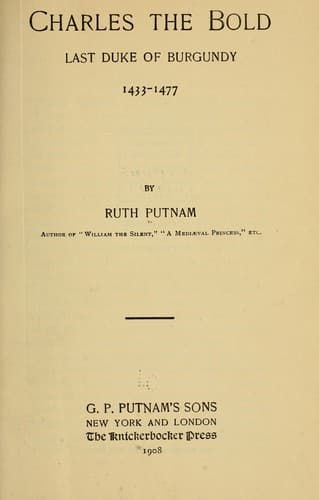
Charles the Bold, Last Duke of Burgundy, 1433-1477Putnam, Ruth
History
Charles the Bold, Last Duke of Burgundy, 1433-1477
Putnam, Ruth
Burgundy (France) -- History; Charles, Duke of Burgundy, 1433-1477; Switzerland -- History -- 1032-1499
Chastellain acknowledges that Charles is accused of avarice, but
defends him on the ground that he has been driven into collecting
a large army. "A penny in the chest is worth three in the purse of
another." "To take precautions in advance is a way to save honour and
property," prudently adds the historian, who evidently flourishes
his maxims to strengthen his own appreciation of the duke's economy,
which, quite as evidently, is not pleasing to him. "I have seen him
the very opposite of miserly, open-handed and liberal, rejoicing in
largesse. When he came into his seigniory his nature did not change."
It was simply the exigencies of his critical position that forced him
to restrain his natural propensities and thus to gain the undeserved
reputation for parsimony.
It was also said that he was a very hard taskmaster, but as a matter
of fact he demanded nothing of his soldiers that he was not ready to
undertake himself. Like a true duke, he was his own commander, drew up
his own troops himself in battle array, and then passed from one end
of the line to the other, encouraging the men individually with cheery
words, promising them glory and profit, and pledging himself to share
their dangers. In victory he was restrained and showed more mercy than
cruelty.
After expatiating on the points where Charles was like his
father--conventional princely qualities --Chastellain adds: "In some
respects they differed. The one was cold and the other boiling with
ardour; the one slow and prone to delay, the other strenuous in his
promptness; the elder negligent of his own concerns, the younger
diligent and alert. They differed in the amount of time consumed at
meals and in the number of guests whom they entertained. They differed
more or less in their voluptuousness and in their expenditures and in
the way in which they took solace and amusement." But in all other
respects, "in life they marched side by side as equals and if it
please God He will be their conductor in glory everlasting" is the
final assurance of their eulogist.
Yet, lavish as the Burgundian poet is in his adjectives about his
patron, there is considerable discrimination between his summaries of
the two dukes. It is very evident that from his accession Charles
was less of a favourite than his father. While endeavouring to be
as complimentary as possible, distrust of his capacities creeps out
between the lines. Chastellain died in 1475, and thus never saw
Charles's final disaster. But the violence of his character had
inspired lack of confidence in his power of achievement, a violence
that made people dislike him as Philip with all his faults was never
disliked.
[Footnote 1: Du Clercq, iv., 302 _et seq_. Erasmus was born in this
year, 1467.]
[Footnote 2: II., 49.]
[Footnote 3: "Non par armes attachées à espingles."]
[Footnote 4: _Oeuvres_, vii., 213.]
CHAPTER IX
THE UNJOYOUS ENTRY
1467
Public-domain text, read in full here on John Shaqi.
Reviews
Reviews
No reviews yet
Be the first to share your thoughts on this work.
Elsewhere in the archive
Join the Discussion
Join the discussion
Sign in to leave a comment or review.
Sign InorCreate an account