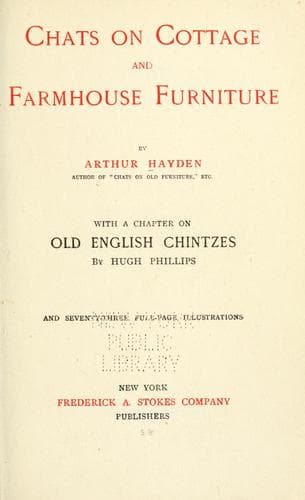
Chats on Cottage and Farmhouse FurnitureHayden, Arthur
History
Chats on Cottage and Farmhouse Furniture
Hayden, Arthur
Country furniture -- England; Furniture -- England; Textile fabrics -- England
The capital was a place far removed from the country. It was seldom
that the country squire paid a visit thither. "Towards London and
Londoners he felt an aversion that more than once produced important
political effects" (Macaulay). Apart from the country gentlemen
were the petty proprietors who cultivated their own fields with
their own hands and enjoyed a modest competence without affecting
to have scutcheons and crests. This great class of yeomanry formed
a much more important part of the nation than now. According to the
most reliable statistics of the seventeenth century, there were no
less than a hundred and sixty thousand proprietors, who with their
families made a seventh of the population of those days, and these
derived their livelihood from small freehold estates.
Such, then, were the chief differences dividing the life of the
country from the life of the town. The London merchants had town
mansions hardly less inferior to the nobility. Chelsea was a quiet
village with a thousand inhabitants, and sportsmen with dog and gun
wandered over Marylebone. General Oglethorpe, who died in 1785, used
to boast that he had shot a woodcock in what is now Regent Street, in
Queen Anne's reign.
The days of the Stuarts were not so rosy as writers of romance
have chosen to have us believe. At Norwich, the centre of the cloth
industry, children of the tender age of six were engaged in labour.
At Bristol a labyrinth of narrow lanes, too narrow for cart traffic,
was built over vaults. Goods were conveyed across the city in trucks
drawn by dogs. Meat was so dear that King, in his "Natural and
Political Conclusions," estimates that half the population of the
country only ate animal food twice a week, and the other half only
once a week or not at all. "Bread such as is now given to the inmates
of a workhouse was then seldom seen even on the trencher of a yeoman
or a shopkeeper. The majority of the nation lived almost entirely on
rye, barley, and oats."
The change from these conditions to those we associate with the
eighteenth century was not a sudden but a slow one. With the increase
of average prosperity came the additional requirements in household
furniture. It is impossible now to state accurately what the exact
furniture was of the various classes of the community. Many of the
seventeenth-century pieces now remaining have been treasured in great
houses and belong to a variety which in those days was regarded as
sumptuous. Now and again we catch glimpses of the former life of the
men and women of those days. Little pieces of conclusive evidence
are brought to light which enable safe conclusions to be drawn. But
the everyday normal character has too often gone unrecorded. We are
left with Court memoirs, diaries of the great, literary proofs of the
more scholarly, but the simple annals of the poor are, in the main,
unrecorded.
Public-domain text, read in full here on John Shaqi.
Reviews
Reviews
No reviews yet
Be the first to share your thoughts on this work.
Join the Discussion
Join the discussion
Sign in to leave a comment or review.
Sign InorCreate an account