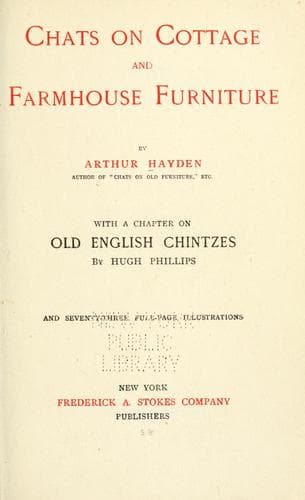
Chats on Cottage and Farmhouse FurnitureHayden, Arthur
History
Chats on Cottage and Farmhouse Furniture
Hayden, Arthur
Country furniture -- England; Furniture -- England; Textile fabrics -- England
Of this particular type of oak Dresser the two examples illustrated
(p. 117) have characteristics which are common to the class. The
geometric front panels, the laid-on moulding, and the Jacobean
leg--in most cases the back legs of these side dressers are
square--should be intently noticed. In regard to the number of
the legs, this is governed by the length of the dresser. In the
lower example it will be seen that there are six legs and that the
stretcher is continued round three sides. In this example the legs
begin to show indications of the late-Jacobean style of more delicate
turning. In the upper example the legs are bolder.
These are oak specimens; the walnut varieties of similar design offer
more sumptuous decoration and belong to furniture more suitable for
the manor house than for the farm or cottage.
An earlier type, in date about 1660, illustrated p. 119, exhibits a
less ornate appearance and has the split urn-shaped legs in front and
flat legs at the back. The split legs are found sometimes in gate
tables, but when such is the case it may safely be conjectured that
these tables are not of English origin, as the split leg did not find
great favour with the English cabinet-makers.
Before passing to later examples it should be observed that this
particular form of dresser is most frequently found without a top
with shelves. Examples there are which, as we shall show, have the
original top, but as a rule it is advisable to note this feature
in examining these Jacobean dressers, for there are a great number
in the market to which later tops have been added, as suitable to
more modern requirements, or as likely to prove more attractive to
those collectors not familiar with the dresser in its earlier form.
Originally in early dressers with shelves there is no back, that is
to say, the shelves showed the wall behind them. This deficiency has
been obligingly supplied by later hands.
The dresser, as it found itself after certain transitional stages had
been passed through, is shown in the early eighteenth-century piece
illustrated (p. 119). This is of the early days of the eighteenth
century, that is to say, in the reign of Queen Anne. It is here seen
that the dresser is a set piece of furniture possessing attributes
instantly marking it as having been carefully designed with a due
observance as to the purpose to which it was to be put. The shelf at
the bottom was evidently intended for use; the arched formation below
the drawers has been planned in that manner to admit of utensils
placed there being taken out and replaced with ease. One can only
conjecture what may have stood there, maybe a barrel of cider, or
perhaps only a breadpan.
Public-domain text, read in full here on John Shaqi.
Reviews
Reviews
No reviews yet
Be the first to share your thoughts on this work.
Join the Discussion
Join the discussion
Sign in to leave a comment or review.
Sign InorCreate an account