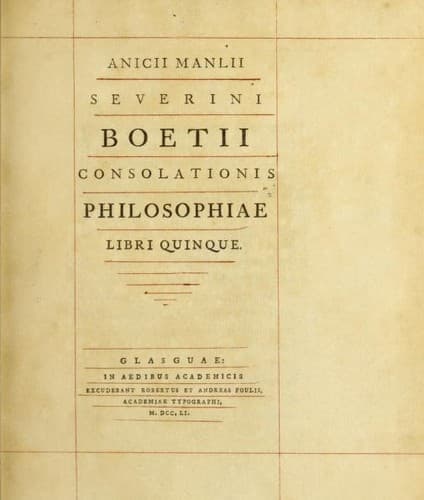
Chaucer's Translation of Boethius's "De Consolatione Philosophiae"Boethius
ReligionComparative
Chaucer's Translation of Boethius's "De Consolatione Philosophiae"
Boethius
Happiness; Philosophy and religion
alle þise oþer þinges forsoþe 1796
ben taken for cause of power. or ellis for cause of
delit.
[Sidenote: The goods of the body fall under the same predicament.]
¶ Certis now am I redy to referen þe goodes of
þe body to þise forseide þinges abouen.
[Sidenote: Strength and a good stature seem to give power and
worthiness.]
¶ For it semeþ
þ{a}t strengþe {and} gretnesse of body ȝeuen power {and} 1800
worþinesse.
[Sidenote: Beauty and swiftness give glory and fame; and health
gives delight.]
¶ and þat beaute {and} swiftenesse ȝeuen
noblesse {and} glorie of renou{n}. {and} hele of body semeþ
ȝiuen delit.
[Sidenote: In all these happiness alone is sought.]
¶ In alle þise þi{n}g{us} it semeþ oonly þat
blisfulnesse is desired.
[Sidenote: What a man most wishes for, that he esteems the supreme
good, which, as we have defined, is happiness.]
¶ For-whi þilke þing þat euery 1804
man desireþ moost ouer alle þinges. he demiþ þat be þe
souereyne goode. ¶ But I haue diffined þat blisfulnesse
is þe souereyne goode. for whiche euery wyȝt
demiþ þat þilke estat þat he desireþ ouer alle þinges þat 1808
it be þe blisfulnesse.
[Sidenote: Thou hast now before thee a view of human felicity
(falsely so called), that is, riches, honours, power, glory, and
delight, which last _Epicurus_ considered as the sovereign good.]
¶ Now hast þou þan byforne
[thy eyen] almost al þe p{ur}posed forme of þe welfulnesse
of ma{n}ky{n}de. þat is to seyne rycchesse. hono{ur}s.
power. glorie. {and} delitȝ. þe whiche delit oonly considered 1812
Epicurus Iuged {and} establissed. þat delit is þe
souereyne goode. for as myche as alle oþer þinges as
hym þouȝt[e] by-refte awey ioie {and} myrþe fro{m} þe
herte.
[Sidenote: I now return to the inclinations and pursuits of
mankind.]
¶ But I reto{ur}ne aȝeyne to þe studies of meen. 1816
of whiche men þe corage alwey rehersiþ {and} seekeþ þe [[pg 67]]
souereyne goode of alle be it so þ{a}t it be wiþ a derke
memorie [but he not by whiche paath].
[Sidenote: Their minds are bent upon the chief good, and are ever
seeking it with a darkened understanding, like a drunken man, who
cannot find his way home.]
¶ Ryȝt as a
dronke ma{n} not nat by whiche paþe he may reto{ur}ne 1820
home to hys house.
[Sidenote: Do they go astray who strive to keep themselves from
want?]
¶ Semeþ it þanne þat folk folyen
{and} erren þat enforcen he{m} to haue nede of no þing
Public-domain text, read in full here on John Shaqi.
Reviews
Reviews
No reviews yet
Be the first to share your thoughts on this work.
Elsewhere in the archive
Join the Discussion
Join the discussion
Sign in to leave a comment or review.
Sign InorCreate an account