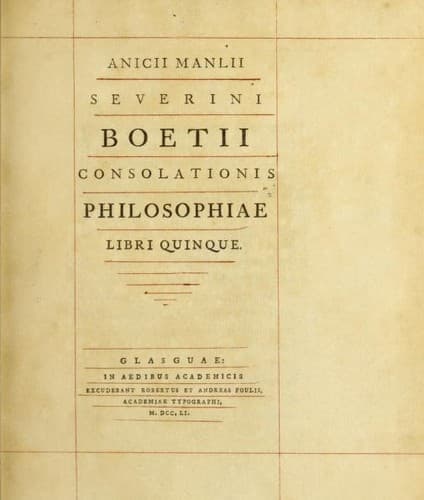
Chaucer's Translation of Boethius's "De Consolatione Philosophiae"Boethius
ReligionComparative
Chaucer's Translation of Boethius's "De Consolatione Philosophiae"
Boethius
Happiness; Philosophy and religion
¶ A tyraunt þat was kyng of sisile þat had[de] assaied
þe p{er}il of his estat shewid[e] by similitude þe dredes
of realmes by gastnesse of a swerde þat heng ouer þe
heued of his familier.
[Sidenote: What then is this thing called Power, which cannot do
away with care or fear?]
what þing is þan þis power þat 2080
may nat don awey þe bytynges of besines ne eschewe [[pg 76]]
þe prikkes of drede.
[Sidenote: Men would live in security but cannot, and yet they
glory in their power.]
[Sidenote: [* fol. 18.]]
and certys ȝit wolden þei lyuen
*in sykernesse. but þei may nat. and ȝit þei glorifien
hem in her power
[Sidenote: Is he powerful who cannot do what he wishes?]
¶ Holdest þou þan þat þilk[e] man 2084
be myȝty þat þ{o}u seest þat he wolde don þat he may
nat don.
[Sidenote: Is he a mighty man who goes surrounded with an armed
guard, to terrify those whom he himself fears, and whose power
depends solely upon his numerous retinue?]
¶ And holdest þou þan hym a myȝty man
þat haþ environed hise sydes wiþ men of armes or
seruauntes {and} dredeþ more [hem] þat he makeþ agast. 2088
þen þei dreden hym. {and} þat is put in þe handes of hise
seruauntȝ. for he sholde seme myȝty but of familiers
[or] seruauntȝ of ky{n}ges.
[Sidenote: Why need I enlarge upon the favourites of princes
having thus displayed the imbecility of kings!]
¶ what sholde I telle þe
any þing. syn þat I my self haue shewed þe þat realmes 2092
hem self ben ful of gret feblenesse.
[Sidenote: Their prosperity is affected by the caprice of their
fortunate masters as well as by the adversity to which they are
incident.]
þe whiche familiers
certis þe real power of kynges in hool estat {and} in estat
abated ful [ofte] þroweþ adou{n}.
[Sidenote: Nero only allowed his master Seneca to choose the
manner of his death.]
¶ Nero co{n}streined[e]
his familier {and} his maistre seneca to chesen on what 2096
deeþ he wolde deien.
[Sidenote: Antonius (Caracalla) commanded Papinian to be slain by
the swords of his soldiers.]
¶ Antonius comau{n}did[e] þat
knyȝtis slowen wiþ her swerdis Papinian his familier
whiche Papinian had[de] ben long tyme ful myȝty
a-monges hem of þe courte.
[Sidenote: Yet both would have given up all they possessed.]
and ȝit certis þei wolde boþe 2100
han renou{n}ced her power.
[Sidenote: Seneca begged for poverty and exile. But relentless
fortune precipitated them to destruction, and did not permit them
to choose their fate.]
Public-domain text, read in full here on John Shaqi.
Reviews
Reviews
No reviews yet
Be the first to share your thoughts on this work.
Elsewhere in the archive
Join the Discussion
Join the discussion
Sign in to leave a comment or review.
Sign InorCreate an account