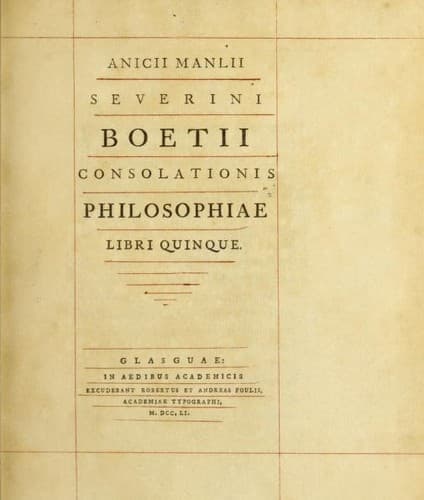
Chaucer's Translation of Boethius's "De Consolatione Philosophiae"Boethius
ReligionComparative
Chaucer's Translation of Boethius's "De Consolatione Philosophiae"
Boethius
Happiness; Philosophy and religion
¶ For but yif I be by-giled.
þan is þilke þe verray p{er}fit blisfulnesse þat p{er}fitly
makiþ a man suffisau{n}t. myȝty. hono{ur}able noble. 2380
{and} ful of gladnesse. {and} for þou shalt wel knowe þat I
haue wel vndirstonden þise þinges wiþ i{n}ne myne herte.
I knowe wel þilke blisfulnesse þat may verrayly ȝeuen
on of þe forseide þinges syn þei ben al oon .I. knowe 2384
douteles þat þilke þing is þe fulle of blysfulnesse.
[Sidenote: _P._ O my nursling, how happy are you in this
conviction, provided you add but one limitation.]
_P._ O my nurry q{uod} she by þis oppiniou{n} q{uo}d she I
sey[e] þat þou art blisful yif þou putte þis þer to þat I
shal seine.
[Sidenote: _B._ What is that?]
what is þat q{uo}d .I.
[Sidenote: _P._ Thinkest thou that any thing in this world can
confer this happiness? (the sovereign good).]
¶ Trowest þou þat 2388
þer be any þing in þis erþely mortal toumblyng þinges
þat may bryngen þis estat.
[Sidenote: _B._ I think not; for nothing can be desirable beyond
such a state of perfection.]
Certys q{uo}d I trowe it nat.
{and} þou hast shewed me wel þat ouer þilke goode þer
is no þing more to ben desired.
[Sidenote: _P._ These imperfect things above mentioned only confer
the shadow of the supreme good, or at most only an imperfect
felicity, but they cannot bestow true and perfect happiness.]
_P._ þise þinges þan 2392
q{uo}d she. þat is to seyne erþely suffisaunce {and} power.
{and} swiche þinges eyþer þei semen likenesse of verray
goode. or ellys it semeþ þat þei ȝeuen to mortal folk a
maner of goodes þat ne ben nat perfit. ¶ But þilke 2396
goode þat is verray {and} p{er}fit. þat may þei nat ȝeuen.
[Sidenote: _B._ I quite agree with you.]
_boice._ I. accorde me wel q{uo}d .I.
[Sidenote: _P._ Then, knowing the difference between true and
false felicity you must now learn where to look for this supreme
felicity.]
þan q{uo}d she for as
moche as þou hast knowen whiche is þilke verray blisfulnesse.
{and} eke whiche þilke þinges ben þat lien 2400
falsly blisfulnesse. þat is to seyne. þat by desceit
seme{n} verray goodes.
[Sidenote: [* fol. 20 _b_.]]
¶ Now byhoueþ þe to knowe{n}
*whennes {and} where þou mowe seek[e] þilke verray
blisfulnesse. ¶ Certys q{uo}d I þat desijr I gretly {and} 2404
haue abiden longe tyme to herkene it.
[Sidenote: _P._ But, as Plato says that even in the least things
the Divine assistance ought to be implored, what ought we do, to
render us worthy of so important a discovery as the true source
and seat of the sovereign good?]
Public-domain text, read in full here on John Shaqi.
Reviews
Reviews
No reviews yet
Be the first to share your thoughts on this work.
Elsewhere in the archive
Join the Discussion
Join the discussion
Sign in to leave a comment or review.
Sign InorCreate an account