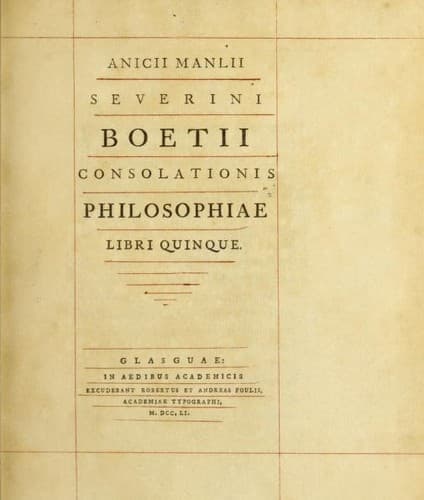
Chaucer's Translation of Boethius's "De Consolatione Philosophiae"Boethius
ReligionComparative
Chaucer's Translation of Boethius's "De Consolatione Philosophiae"
Boethius
Happiness; Philosophy and religion
{and} in þis þing I trowe þat we sholden first enquere
forto witen yif þat any swiche manere goode as þilke
goode þat þou hast diffinissed a lytel her byforne. þat
is to seine souereyne goode may be founden in þe nature 2460
of þinges. For þat veyne ymaginac{i}ou{n} of þouȝt ne
desceiue vs nat. {and} putte vs oute of þe soþefastnesse
of þilke þinge þat is su{m}myttid to vs. þis is to seyne.
but it may nat ben denoyed þat þilke goode ne is. 2464
¶ and þat it nis ryȝt as a welle of alle goodes.
[Sidenote: The sovereign good does exist, and is the source of all
other good.]
¶ For
al þing þat is cleped i{n}p{er}fit.
is proued i{n}p{er}fit by þe [[pg 89]]
amenusynge of p{er}fecc{i}ou{n}. or of þing þat is p{er}fit.
[Sidenote: [* fol. 21.]]
[Sidenote: When we say that a thing is _imperfect_ we assert that
there is something else of its kind _perfect_.]
{and} her of comeþ it. þat in euery þing general. yif þat. 2468
þat men seen any þing þat is i{n}p{er}fit *certys in þilke general
þer mot ben so{m}me þing þat is p{er}fit. ¶ For yif so
be þat p{er}fecc{i}ou{n} is don awey. men may nat þinke
nor seye fro whe{n}nes þilke þing is þat is cleped inperfit. 2472
[Sidenote: Nature takes not her origin from things diminished and
imperfect; but, proceeding from an entire and absolute substance,
descends into the remotest and most fruitless things.]
¶ For þe nature of þinges ne token nat her bygynnyng
of þinges amenused {and} i{n}p{er}fit. but it p{ro}cediþ of
þi{n}g{us} þat ben al hool. {and} absolut. {and} descendeþ so
doune in to outerest þinges {and} in to þi{n}g{us} empty {and} 2476
wiþ oute fruyt.
[Sidenote: If there be an imperfect and fading felicity there must
also be one stable and perfect.]
but as I haue shewed a litel her byforne.
þat yif þer be a blisfulnesse þat be frele {and} vein {and}
inp{er}fit. þer may no man doute. þat þer nys som blisfulnesse
þat is sad stedfast {and} p{er}fit. b. þis is concludid 2480
q{uo}d I fermely {and} soþefastly.
[Sidenote: But now consider wherein this felicity resides. That
God is the governor of all things is proved by the universal
opinion of all men.]
_P._ But co{n}sidere
also q{uo}d she in wham þis blisfulnesse enhabiteþ. þe
co{m}mune acordaunce {and} conceite of þe corages of men
p{ro}ueþ {and} graunteþ þat god p{r}ince of alle þi{n}g{us} is 2484
good.
[Sidenote: For since nothing may be conceived better than God,
then He who has no equal in goodness must be good.]
¶ For so as no þing ne may ben þouȝt bettre þan
god. it may nat ben douted þan þat [he þ{a}t] no þing is
bettre. þat he nys good.
[Sidenote: Reason clearly demonstrates (1) that God is good, and
(2) that the sovereign good exists in him.]
Public-domain text, read in full here on John Shaqi.
Reviews
Reviews
No reviews yet
Be the first to share your thoughts on this work.
Elsewhere in the archive
Join the Discussion
Join the discussion
Sign in to leave a comment or review.
Sign InorCreate an account