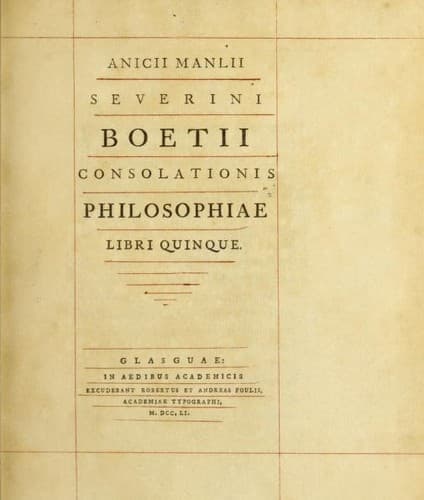
Chaucer's Translation of Boethius's "De Consolatione Philosophiae"Boethius
ReligionComparative
Chaucer's Translation of Boethius's "De Consolatione Philosophiae"
Boethius
Happiness; Philosophy and religion
¶ But I p{re}ie þe q{uo}d she see now how
þou mayst preuen holily {and} wiþ-oute{n} corrupciou{n} þis
þat I haue seid. þat þe souereyne god is ryȝt ful of 2504
souereyne goode. [In whych man{er}e q{uo}d I.] wenest
þou ouȝt q{uo}d she þat þis p{r}ince of alle þinges haue
ytake þilke souereyne good any where þan of hym self.
¶ of whiche souereyne goode men p{ro}ueþ þat he is ful 2508
ryȝt as þou myȝtest þinken. þat god þat haþ blisfulnesse
in hym self. {and} þat ilke blisfulnesse þat is in hym
were diu{er}s in substaunce.
[Sidenote: If you think that God has received this good from
without, then you must believe that the giver of this good is more
excellent than God the receiver.]
¶ For yif þou wene þat
god haue receyued þilke good oute of hy{m} self. þou 2512
mayst wene þat he þat ȝaf þilke good to god. be more
goode þan is god.
[Sidenote: But we have concluded that there is nothing more
excellent than God.]
¶ But I am byknowen {and} confesse
{and} þat ryȝt dignely þat god is ryȝt worþi abouen alle
þinges.
[Sidenote: But if this supreme good is in Him by nature, and is
nevertheless of a different substance, we cannot conceive, since
God is the author of all things, what could have united these two
substances differing one from another.]
¶ And yif so be þat þis good be in hym by 2516
nature. but þat it is diu{er}s from [hym] by wenyng
resou{n}. syn we speke of god p{r}ince of alle þinges feyne
who so feyne may. who was he þat [hath] co{n}ioigned
þise diu{er}s þinges to-gidre.
[Sidenote: Lastly, a thing which essentially differs from another
cannot be the same with that from which it is supposed to differ.]
{and} eke at þe last[e] se 2520
wel þat o þing þat is diu{er}s from any þing. þat þilke
þing nis nat þat same þing. fro whiche it is vndirstonde{n}
to ben diu{er}s.
[Sidenote: Consequently, what in its nature differs from the chief
good cannot be the supreme good.]
þan folweþ it. þat þilke þi{n}g þat
by hys nature is dyuers from souereyne good. þat þat 2524
þing nys nat souereyne good.
[Sidenote: But it would be impious and profane thus to conceive of
God, since nothing can excel Him in goodness and worth.]
but certys þat were a
felonous corsednesse to þinken þat of hym. þat no þing
nis more worþe.
[Sidenote: In fact, nothing can exist whose nature is better than
its origin.]
For alwey of alle þinges. þe nat{ur}e
of hem ne may nat ben better þan his bygy{n}nyng. 2528
Public-domain text, read in full here on John Shaqi.
Reviews
Reviews
No reviews yet
Be the first to share your thoughts on this work.
Elsewhere in the archive
Join the Discussion
Join the discussion
Sign in to leave a comment or review.
Sign InorCreate an account