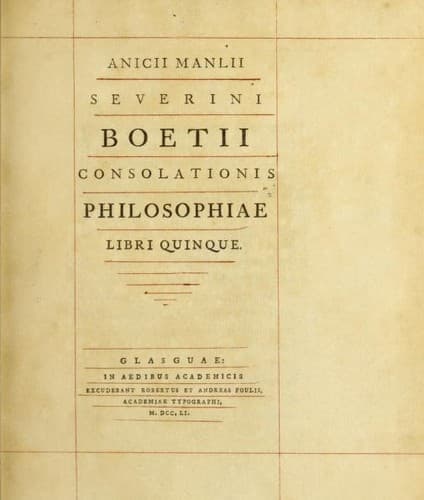
Chaucer's Translation of Boethius's "De Consolatione Philosophiae"Boethius
ReligionComparative
Chaucer's Translation of Boethius's "De Consolatione Philosophiae"
Boethius
Happiness; Philosophy and religion
[Linenotes:
2495 [_that_]--from C.
2496 _proces_--p{ro}cesses
2497 _ouȝt[e]_--owen
2498 _goode_--good
2499 _souereyne goode_--souereyn good
2500 [_þat----is_]--from C.
_yset_--MS. ysette, C. set
2501 _be_--ben
_wiþseid_--MS. wiþseide, C. withseid
2503 _wiþ-outen_--w{i}t{h}-owte
2504 _seid_--MS. seide, C. seyd
2505 _souereyne goode_--souereyn good
[_In----I_]--from C.
2506 _ouȝt_--awht
2507 _þan of_--owt of
2508 _whiche_--whych
_souereyne goode_--souereyn good
2509 _haþ_--MS. haþe
2510 _þat ilke_--thilke
2511 _were_--weren
2514 _goode_--worth
2517 _from_--fro
[_hym_]--from C.
2518 _feyne_--faigne
2519 _feyne_--feigne
[_hath_]--from C.
2520 _last[e]_--laste
2521 _o_--a
2522 _whiche_--whych
2524 _from_--fro
2527 _nis_--is
2528 _better_--bettre]
[Headnote:
THERE CANNOT BE TWO CHIEF GOODS.]
[Sidenote: We may therefore conclude that the Author of all things
is really and substantially the supreme Good.]
¶ For whiche I may concluden by ryȝt uerray resou{n}. [[pg 91]]
þat þilke þat is bygynnyng of alle þinges. þilke same
þing is good in his substaunce.
[Sidenote: _B._ Most rightly said!]
_B._ þou hast seid ryȝtfully
q{uo}d .I.
[Sidenote: _P._ But you have owned that true felicity is the
sovereign good; then you must also grant that God is that true
felicity.]
_P._ But we han graunted q{uo}d she þat 2532
souereyne good is blysfulnes. þat is soþe q{uo}d .I. þan
q{uo}d she mote we nedes graunten {and} confessen þat
þilke same souereyne goode be god.
[Sidenote: _B._ Your conclusions follow from your premises.]
[Sidenote: [* fol. 21 _b_.]]
¶ Certys *q{uo}d
.I. I ne may nat denye ne wiþstonde þe resou{n}s p{ur}posed. 2536
and I see wel þat it folweþ by strengþe of þe
p{re}misses.
[Sidenote: _P._ Let us see whether we cannot prove this more
convincingly by considering it in this view, that there cannot be
two sovereign goods which differ in themselves.]
¶ Loke nowe q{uo}d she yif þis be proued
[yit] more fermely þus. ¶ þat þer ne mowen nat ben
two souereyne goodes þat ben diuerse amo[n]ges hem 2540
self.
[Sidenote: For it is plain that of the goods that differ one
cannot be what the other is; wherefore neither of them can be
perfect where one wants the other.]
þat on is nat þat þat oþer is. þan [ne] mowen
neiþer of hem ben p{er}fit. so as eyþer of hem lakkiþ to
oþir.
[Sidenote: That which is not perfect cannot be the supreme good.]
but þat þat nis nat p{er}fit men may seen apertly
þat it nis nat souereyne.
[Sidenote: Neither can the chief good be essentially different.]
Public-domain text, read in full here on John Shaqi.
Reviews
Reviews
No reviews yet
Be the first to share your thoughts on this work.
Elsewhere in the archive
Join the Discussion
Join the discussion
Sign in to leave a comment or review.
Sign InorCreate an account