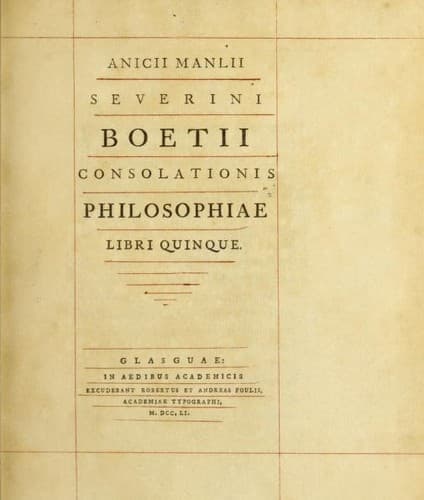
Chaucer's Translation of Boethius's "De Consolatione Philosophiae"Boethius
ReligionComparative
Chaucer's Translation of Boethius's "De Consolatione Philosophiae"
Boethius
Happiness; Philosophy and religion
[Sidenote: _P._ Do you not perceive that everything which exists
is permanent so long as it preserves its unity--but as soon as it
loses this, it is dissolved and annihilated?]
¶ Hast þou nat knowen wel q{uo}d
she. þat al þing þat is haþ so longe his dwellyng {and}
his substaunce. as longe is it oone. ¶ but wha{n} it 2696
forletiþ to ben oone it mot nedis dien {and} corrumpe togidre.
[Sidenote: _B._ How so?]
¶ In whiche manere q{uo}d .I.
[Sidenote: _P._ In the animal creation as long as the soul and the
body are united and conjoined in one, this being is called an
animal or beast, but when the union is dissolved by the separation
of these, the animal perishes and is no longer a beast.]
¶ Ryȝt as in
beestes q{uod} she. whan þe soule {and} þe body ben
co{n}ioigned in oon {and} dwellen to-gidre it is cleped a 2700
beest. {and} whan hire vnite is destroied by disseueraunce
þat oon fram þ{a}t oþir. þan sheweþ it wel þat it is a
dede þi{n}g. {and} þat it is no lenger no beste.
[Sidenote: The same may be said of man and all other things; they
subsist while unity is preserved, but as soon as that is destroyed
the things themselves lose their existence.]
{and} þe
body of a wyȝt while it dwelleþ in oon forme by coniuncc{i}ou{n} 2704
of membris it is wel seyn þat it is a figure of
mankynde. and yif þe partyes of þe body ben [so]
diuide[d] {and} disseuered þat oon fro þat oþir þat þei
destroien vnite. þe body forletiþ to ben þat it was byforne. 2708
¶ And who so wolde renne in þe same manere
by alle þinges he sholde seen þat wiþ outen doute euery
þinge is in his substaunce as longe as it is oon. {and}
whan it forletiþ to ben oon it dieþ {and} p{er}issiþ.
[Sidenote: _B._ I believe we should find this true in every case.]
_boice._ 2712
whan I considre q{uo}d I many þinges I see noon oþ{er}.
[Linenotes:
2690 _mayst þou graunt[en]_--mosthow grau{n}ten
2692 [_of_]--from C.
2695 _al_--alle
_haþ_--MS. haþe
2696, 2697 _oone_--oon
2698 _whiche_--which
2703 _dede_--ded
_lenger_--lenger{e}
_beste_--beest
2704 _while_--whil
_oon_--oo
2706 _[so] diuide[d]_--so deuydyd
2709 _so_--omitted
2713 _many_--manye]
[Headnote:
NATURE SUSTAINS VEGETATION.]
[Sidenote: _P._ Is there anything which acts naturally that
forgoes this desire of existence and wishes for death and
corruption?]
¶ Is þer any þing þanne q{uo}d she þat in as moche as
it lyueþ naturely. þat forletiþ þe appetit or talent of 2715
hys beynge. {and} desireþ to come to deeþ
{and} to corrupc{i}ou{n}. [[pg 97]]
Public-domain text, read in full here on John Shaqi.
Reviews
Reviews
No reviews yet
Be the first to share your thoughts on this work.
Elsewhere in the archive
Join the Discussion
Join the discussion
Sign in to leave a comment or review.
Sign InorCreate an account