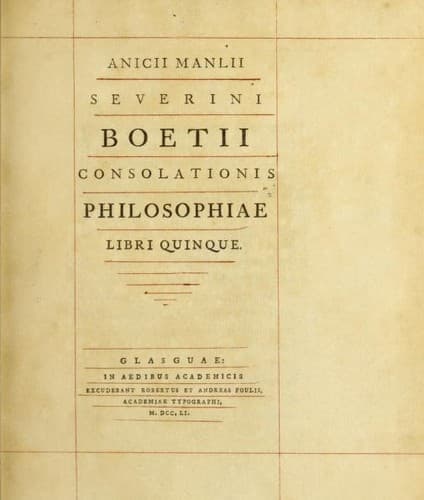
Chaucer's Translation of Boethius's "De Consolatione Philosophiae"Boethius
ReligionComparative
Chaucer's Translation of Boethius's "De Consolatione Philosophiae"
Boethius
Happiness; Philosophy and religion
*¶ For þe realme ne sholde not seme blisful ȝif þere were a ȝok
of mysdrawynges in diu{er}se p{ar}ties ne þe sauynge of 2944
obedient þinges ne sholde nat be.
[Sidenote: _P._ Is there anything that follows the dictates of
nature that seeks to counteract the will of God?]
þan is þere no þing
q{uo}d she þ{a}t kepiþ hys nature[;] þat enforceþ hym to
gone aȝeyne god.
[Sidenote: _B._ No.]
¶ No q{uo}d. I.
[Sidenote: _P._ If there should be any such, it could not prevail
against him, who is supremely happy and consequently omnipotent.]
¶ And if þat any þi{n}g
enforced[e] hym to wiþstonde god. myȝt[e] it auayle at 2948
þe laste aȝeyns hym þat we han g{ra}unted to ben al
myȝty by þe ryȝt of blisfulnesse. ¶ Certis q{uo}d I al
outerly it ne myȝt[e] nat auaylen hym.
[Sidenote: Then there is nothing that either will or can withstand
this supreme good?]
þan is þere no
þing q{uo}d she þat eyþer wol or may wiþstonde to þis 2952
souereyne good.
[Sidenote: _B._ Nothing, certainly.]
¶ I trowe nat q{uo}d. I
[Sidenote: _P._ It is then the supreme good that governs and
orders all things powerfully and benignly.]
¶ þan is
þilke þe souereyne good q{uo}d she þat alle þi{n}g{us}
gouerneþ strongly {and} ordeyneþ hem softly.
[Sidenote: _B._ I am delighted with your _conclusions_, but much
more with your _language_; so that fools may be ashamed of their
objections to the divine government.]
þa{n} seide I
þus. I delite me q{uo}d I nat oonly in þe endes or in þe 2956
so{m}mes of [the] resou{n}s þat þou hast concludid {and}
p{ro}ued. ¶ But þilke wordes þat þ{o}u vsest deliten me
moche more. ¶ So at þe last[e] fooles þat so{m}tyme
renden greet[e] þinges auȝte{n} ben asshamed of hem 2960
self.
[Sidenote: [Chaucer’s gloss.]]
¶ þat is to seyne þ{a}t we fooles þat rep{re}henden
wickedly þe þi{n}g{us} þat touchen goddes gouernaunce we
auȝte{n} ben asshamed of oure self. As I þat seide god
refuseþ oonly þe werkes of men. {and} ne entremetiþ nat 2964
of he{m}.
[Sidenote: _P._ You have read the Poets’ fables, how the Giants
stormed heaven--how they were repulsed and punished according to
their deserts; but may we not compare our reasons together, for by
so doing some clear spark of truth may shine forth?]
_p._ þou hast wel herd q{uo}d she þe fables of þe
poetes. how þe geauntes assailden þe heuene wiþ þe
goddes. but for soþe þe debonaire force of god disposed[e]
hem so as it was worþi. þat is to seyne distroied[e] þe 2968
geauntes. as it was worþi. ¶ But wilt þou þat we
ioygnen togedre þilke same resou{n}s. for p{er}auenture of
swiche coniuncc{i}ou{n} may sterten vp some faire sp{er}kele
of soþe
[Sidenote: _B._ As you please.]
¶ Do q{uo}d I as þe list.
Public-domain text, read in full here on John Shaqi.
Reviews
Reviews
No reviews yet
Be the first to share your thoughts on this work.
Elsewhere in the archive
Join the Discussion
Join the discussion
Sign in to leave a comment or review.
Sign InorCreate an account