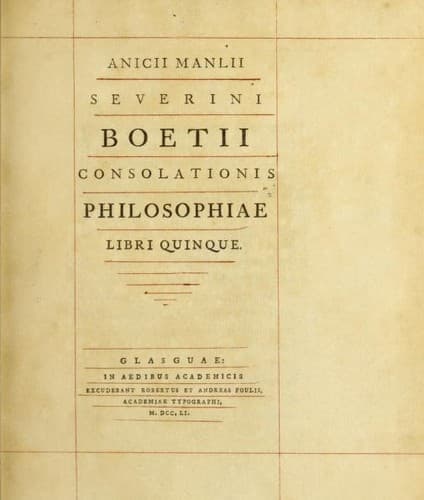
Chaucer's Translation of Boethius's "De Consolatione Philosophiae"Boethius
ReligionComparative
Chaucer's Translation of Boethius's "De Consolatione Philosophiae"
Boethius
Happiness; Philosophy and religion
[Sidenote: But to convince you I shall proceed to prove it from
both these principles, establishing these truths, by arguments
drawn first from one of these topics and then from the other.]
but for as moche as þe fey of
my sentence shal be þe more ferme {and} habou{n}daunt. I
wil goon by þat oon wey {and} by þat oþer {and} I wil conferme 3180
þe þinges þat ben p{ur}posed now on þis side {and}
now on þ{a}t syde.
[Sidenote: Two things are necessary to every action--the Will and
the Power; if either be wanting, nothing can be effected.]
¶ Two þinges þer ben in whiche þe
effect of alle þe dedes of man kynde standiþ. þat is to
seyn. wil {and} power. and yif þat oon of þise two fayleþ 3184
þere nis no þing þat may be don.
[Sidenote: A man can do nothing without the concurrence of his
will, and if power faileth the will is of no effect.]
for yif þat wil lakkeþ
þere nys no wyȝt þat vndirtakeþ to done þat he wol not
don. and yif power fayleþ þe wille nis but i{n} ydel {and}
stant for nauȝt.
[Sidenote: Hence, if you see a person desirous of getting what he
cannot procure, you are sure he lacks power to obtain it.]
and þer of comeþ it þat yif þou se a 3188
wyȝt þat wolde gete{n} þat he may nat geten. þou mayst
nat douten þat power ne fayleþ hy{m} to haue{n} þat he
wolde. ¶ þis is open {and} clere q{uo}d I. ne it may nat
ben denyed in no manere.
[Sidenote: And if you see another do what he had a mind to do, can
you doubt that he had the power to do it?]
and yif þou se a wyȝt q{uo}d 3192
she. þat haþ don þat he wolde don þ{o}u nilt nat douten
þat he ne haþ had power to done it.
[Sidenote: _B._ No, surely. _P._ A man, then, is esteemed
powerful in respect of what he is able to do, and weak in
relation to what he is unable to perform.]
no q{uo}d. I. and in
þat. þat euery wyȝt may. in þat þat men may holden
hym myȝty. as who seiþ i{n} as moche as a man is myȝty [[pg 113]]
to done a þing. in so moche men halden hy{m} myȝty. 3197
and in þat þat he ne may. in þat men demen hym to
ben feble.
[Sidenote: _B._ That is true.]
I confesse it wel q{uo}d I.
[Sidenote: _P._ Do you remember that I proved that the will of
man, following different pursuits, seeks happiness only?]
Remembriþ þe q{uo}d
she þat I. haue gadred {and} shewed by forseide resou{n}s 3200
þat al þe entenc{i}ou{n} of þe wil of ma{n}kynde whiche þat
is lad by diuerse studies hastiþ to comen to blisfulnesse.
¶ It reme{m}breþ me wel q{uo}d I þat it hath ben shewed.
Public-domain text, read in full here on John Shaqi.
Reviews
Reviews
No reviews yet
Be the first to share your thoughts on this work.
Elsewhere in the archive
Join the Discussion
Join the discussion
Sign in to leave a comment or review.
Sign InorCreate an account