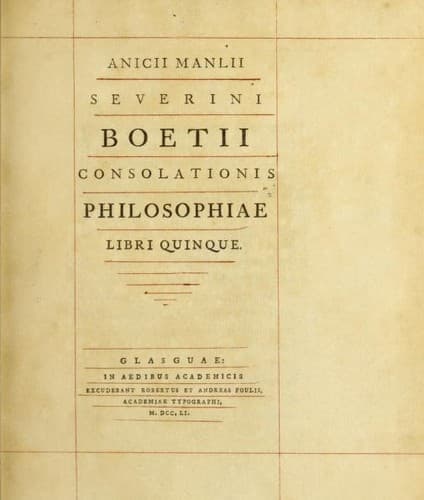
Chaucer's Translation of Boethius's "De Consolatione Philosophiae"Boethius
ReligionComparative
Chaucer's Translation of Boethius's "De Consolatione Philosophiae"
Boethius
Happiness; Philosophy and religion
[Linenotes:
3166 [_owh_]--from C.
3171 _good[e]_--goode
_strong[e]_--stronge
3172 _desert_--dishert
3173 _eueryche_--eu{er}ich
3175 _goode_--good
3176 _stedfast_--stidefast
3177 _freelnesse_--frelenesse
_stedfastnesse_--stidefastnesse
3178 _goode_--good
3180 _oon_--oo
_wil_ (2)--wole
3185-6 _þere_--ther
3185 _don_--MS. done, C. don
3186 _done_--don
3187 _wille_--wil
3188 _comeþ_--comht
3189 _mayst_--MS. mayste, C. mayst
3191 _clere_--cler
3192 _denyed_--denoyed
3193-4 _haþ_--MS. haþe
3193 _don_ (_both_)--MS. done, C. doon
3194 _had_--MS. hadde, C. had
_done_--doon
3196 _as moche_--so moche
3197 _done_--doon
_moche_--mochel
_halden_--halt
3201 _whiche_--which
3202 _lad_--MS. ladde, C. lad
3203 _it hath ben_--MS. I herde þe, C. it hath ben]
[Headnote:
THE IMPOTENCY OF THE WICKED.]
[Sidenote: Do you recollect too, that it has been shown that
happiness is the supreme good of men--and all desire this good,
since all seek happiness?]
{and} recordeþ þe nat þan q{uo}d she. þat blisfulnesse is 3204
þilke same goode þat men requeren.
[Sidenote: [* fol. 25 _b_.]]
so þat whan þat
blisfulnesse is requered *of alle. þat goode [also] is
requered {and} desired of al. It recordeþ me wel q{uo}d I.
for haue it gretly alwey ficche[d] in my memorie.
[Sidenote: All men, then, good and bad, seek to acquire good?]
alle 3208
folk þan q{uo}d she goode {and} eke badde enforcen he{m}
wiþ oute difference of entenc{i}ou{n} to come{n} to goode.
þat is a uerray consequence q{uo}d I.
[Sidenote: And it is certain that when men obtain good they become
good?]
and certeyne is q{uo}d
she þat by þe gety{n}g of goode ben men ymaked goode. 3212
[Sidenote: _B._ It is most certain.]
þis is certeyne q{uo}d. I.
[Sidenote: _P._ Do good men, then, get what they desire?]
¶ þan geten goode men þat þei
desiren.
[Sidenote: _B._ It seems so.]
so semeþ it q{uo}d I.
[Sidenote: _P._ If evil men obtain the good, they can be no longer
evil?]
but wicked[e] folk q{uo}d
she yif þei geten þe goode þat þei desire{n} þei [ne]
mowen nat ben wicked.
[Sidenote: _B._ It is so.]
so is it q{uo}d .I.
[Sidenote: _P._ Since then both parties pursue the good, which
only the virtuous obtain, we must believe that good men are
powerful, and that the wicked are weak and feeble?]
¶ þan so as 3216
þat oon {and} þat oþer [q{uod} she] desiren good. {and} þe
goode folk geten good {and} nat þe wicked folk ¶ þan
nis it no doute þat þe goode folk ne ben myȝty {and} þe
wicked folk ben feble.
Public-domain text, read in full here on John Shaqi.
Reviews
Reviews
No reviews yet
Be the first to share your thoughts on this work.
Elsewhere in the archive
Join the Discussion
Join the discussion
Sign in to leave a comment or review.
Sign InorCreate an account