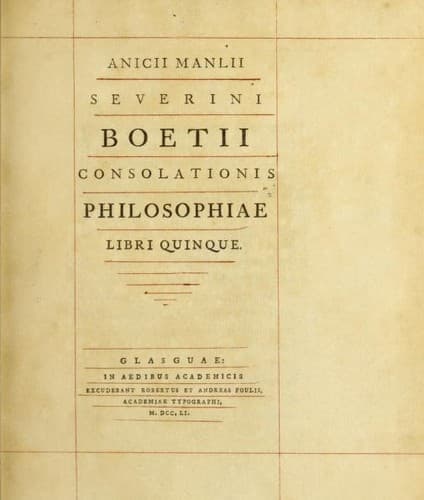
Chaucer's Translation of Boethius's "De Consolatione Philosophiae"Boethius
ReligionComparative
Chaucer's Translation of Boethius's "De Consolatione Philosophiae"
Boethius
Happiness; Philosophy and religion
[Sidenote: _B._ None can doubt this, save such as either consider
not rightly the nature of things, or are incapable of
comprehending the force of any reasoning.]
¶ who so þat euer q{uo}d I 3220
douteþ of þis. he ne may nat considre þe nature of
þi{n}ges. ne þe consequence of resou{n}. and ouer þis q{uo}d she.
[Linenotes:
3205-6 _goode_--good
3206 [_also_]--from C.
3207 _al_--alle
_It----I_--it ne recordeth me nat q{uod} I
3210-12(1)-15 _goode_--good
3214 _wicked[e]_--wikkede
3215 [_ne_]--from C.
3216 _mowen_--mowe
3217 [_quod she_]--from C.
3218 _wicked_--wilk{e} (? wikke)
3220 _wicked_--wikkede]
[Headnote:
THE WICKED DO NOT SEEK ARIGHT THE SUPREME GOOD.]
[Sidenote: _P._ If two beings have the same end in view--and one
of them accomplishes his purpose by the use of natural means,
while the other not using legitimate means does not attain his
end--which of these two is the most powerful?]
¶ yif þat þer ben two þinges þat han o same 3223
p{ur}pos by kynde. {and} þat one of he{m} p{ur}sueþ {and} p{er}formeþ
þilke same þinge by naturel office. {and} þat oþer
ne may nat done þilk naturel office. but folweþ by
oþer manere þan is couenable to nat{ur}e ¶ Hym þat
acomplisiþ hys p{ur}pos kyndely.
{and} ȝit he ne acomplisiþ [[pg 114]]
nat hys owen purpos. wheþer of þise two demest 3229
þou for more myȝty.
[Sidenote: _B._ Illustrate your meaning more clearly.]
¶ yif þat I coniecte q{uo}d .I. þat
þou wilt seye algates. ȝit I desire to herkene it more
pleynely of þe.
[Sidenote: _P._ The motion of walking is natural to man? And this
motion is the natural office of the feet? Do you grant this?]
þou nilt nat þan denye q{uo}d she þat þe 3232
moeueme{n}tȝ of goynge nis in men by kynde. no for soþe
q{uo}d I. ne þou ne doutest nat q{uo}d she þ{a}t þilke naturel
office of goynge ne be þe office of feet.
[Sidenote: _B._ I do.]
I ne doute
it nat q{uo}d .I.
[Sidenote: _P._ If, then, he who is able to use his feet walks,
whilst another lacking this power creeps on his hands--surely he
that is able to move naturally upon his feet is more powerful than
he who cannot.]
þan q{uo}d she yif þat a wyȝt be myȝty to 3236
moeue {and} goþ vpon hys feet. and anoþer to whom
þilke naturel office of feet lakkeþ. enforceþ hym to gone
crepynge vpo{n} hys handes. ¶ whiche of þise two auȝte
to ben holden more myȝty by ryȝt. knyt furþe þe remenaunt 3240
q{uo}d I. ¶ For no wyȝt ne douteþ þat he þat
may gone by nat{ur}el office of feet. ne be more myȝty
þan he þat ne may nat
Public-domain text, read in full here on John Shaqi.
Reviews
Reviews
No reviews yet
Be the first to share your thoughts on this work.
Elsewhere in the archive
Join the Discussion
Join the discussion
Sign in to leave a comment or review.
Sign InorCreate an account