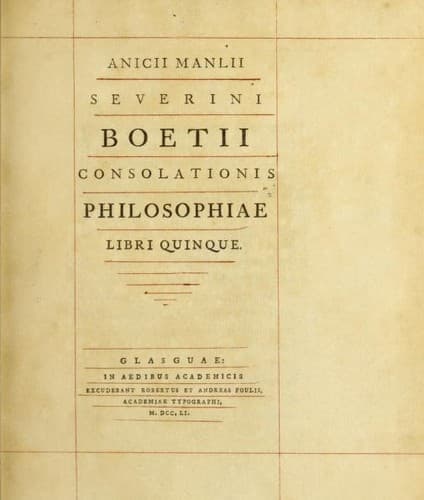
Chaucer's Translation of Boethius's "De Consolatione Philosophiae"Boethius
ReligionComparative
Chaucer's Translation of Boethius's "De Consolatione Philosophiae"
Boethius
Happiness; Philosophy and religion
[Sidenote: _P._ The good and bad seek the supreme good: the good
by the natural means of virtue--the wicked by gratifying divers
desires of earthly things (which is not the natural way of
obtaining it).]
¶ but þe souereyne good q{uo}d
she þat is euenlyche p{ur}posed to þe good folk {and} to 3244
badde. þe good folke seken it by naturel office of
uertues. {and} þe shrewes enforcen hem to geten it by
dyuerse couetise of erþely þinges. whiche þat nis no
naturel office to geten þilke same souereyne goode. 3248
[Sidenote: Do you think otherwise?]
trowest þou þat it be any oþer wyse.
[Sidenote: _B._ The consequence is plain, and that follows from
what has been granted--that the good are powerful, while the
wicked are feeble.]
nay q{uo}d .I. for þe
co{n}seque{n}ce is open {and} shewynge of þinges þat I haue
graunted. ¶ þat nedes goode folk moten ben myȝty.
{and} shrewes feble {and} vnmyȝty.
[Sidenote: _P._ You rightly anticipate me; for it is a good sign,
as physicians well know, when Nature exerts herself and resists
the malady.]
¶ þou rennest aryȝt 3252
byfore me q{uo}d she. {and} þis is þe iugement þat is to
seyn. ¶ I iuge of þe ryȝt as þise leches ben wont forto
hopen of seke folk whan þei ap{er}ceyuen þat nature is
redressed {and} wiþstondeþ to þe maladie.
[Sidenote: But, as you are so quick of apprehension, I shall
continue this mode of reasoning.]
¶ But for I 3256
see þe now al redy to þe vndirstandynge I shal shewe
þe more þilke {and} continuel resou{n}s.
[Sidenote: The weakness of the wicked is conspicuous--they cannot
attain the end to which their natural disposition prompts and
almost compels them; what would become of them without this
natural prompting, so powerful and irresistible?]
¶ For loke now
how gretly shewiþ þe feblesse {and} infirmite of wicked [[pg 115]]
folke. þat ne mowen nat come to þat hire naturel 3260
entenc{i}ou{n} ledeþ hem. {and} ȝitte almost þilk naturel
entenc{i}ou{n} constreineþ hem. ¶ and what wer{e} to deme
þan of shrewes. yif þilke naturel helpe hadde for-leten
hem. ¶ þe whiche naturel helpe of entenc{i}ou{n} goþ alwey 3264
byforne hem. {and} is so grete þat vnneþ it may be
ou{er}comen.
[Sidenote: Consider how great is the impotence of the wicked. (The
greater the things desired, but unaccomplished, the less is the
power of him that desires, and is unable to attain his end.)]
¶ Considre þan how gret defaute of power
{and} how gret feblesse þere is in grete felonous folk as
who seiþ þe gretter þi{n}ges þat ben coueited {and} þe desire 3268
nat accomplissed of þe lasse myȝt is he þat coueiteþ it
{and} may nat acomplisse. ¶ And forþi philosophie seiþ
þus by souereyne good.
Public-domain text, read in full here on John Shaqi.
Reviews
Reviews
No reviews yet
Be the first to share your thoughts on this work.
Elsewhere in the archive
Join the Discussion
Join the discussion
Sign in to leave a comment or review.
Sign InorCreate an account