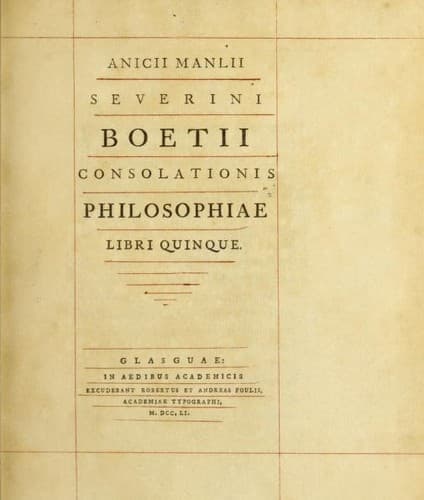
Chaucer's Translation of Boethius's "De Consolatione Philosophiae"Boethius
ReligionComparative
Chaucer's Translation of Boethius's "De Consolatione Philosophiae"
Boethius
Happiness; Philosophy and religion
¶ Of whiche power of good folk men may conclude þat
wicked men semen to ben bareyne {and} naked of alle
strengþe.
[Sidenote: Wherefore do they leave virtue, and follow vice? Is it
because they are ignorant of good?]
For whi forleten þei v{er}tues {and} folwen
vices. nis it nat for þat þei ne knowen nat þe goodes. 3288
[Sidenote: What is more weak and base than the blindness of
ignorance? Or do they know the way they ought to follow, but are
led astray by lust and covetousness?]
¶ But what þing is more feble {and} more caitif þan is þe [[pg 116]]
blyndenesse of ignoraunce. or ellys þei knowen ful wel
whiche þinges þat þei auȝten to folwen ¶ but lecherye
{and} couetise ouerþroweþ hem mysturned.
[Sidenote: And so, indeed, weak-minded men are overpowered by
intemperance, for they cannot resist vicious temptations.]
¶ and certis 3292
so doþ distemp{er}aunce to feble men. þat ne mowe{n} nat
wrastle aȝeins þe vices
[Sidenote: Do they willingly desert Good and turn to Evil? If they
do so, they not only cease to be powerful, but even cease to
exist.]
¶ Ne knowen þei nat þan wel
þat þei foreleten þe good wilfully. {and} turnen hem vilfully
to vices. ¶ And in þis wise þei ne forleten nat 3296
oonly to ben myȝty. but þei forleten al outerly in any
wise forto ben
[Sidenote: For those who neglect the common end of all beings,
cease to exist.]
¶ For þei þat forleten þe comune fyn of
alle þinges þat ben. þei for-leten also þerwiþ al forto
ben.
[Sidenote: You may marvel that I assert that the wicked, the
majority of the human race, have no existence--but it is, however,
most true.]
and p{er}auenture it sholde semen to som folk þat 3300
þis were a merueile to seyne þat shrewes whiche þat
contienen þe more p{ar}tie of me{n} ne ben nat. ne han no
beynge. ¶ but naþeles it is so. {and} þus stant þis þing
[Sidenote: That the wicked are bad I do not deny--but I do not
admit that they have any real existence.]
for þei þat ben shrewes I denye nat þat þei ben shrewes. 3304
but I denye {and} sey[e] symplely and pleynly þat þei
[ne] ben nat. ne han no beynge.
[Sidenote: You may call a corpse a dead man, but you cannot with
propriety call it a man.]
for ryȝt as þou myȝtest
seyn of þe careyne of a man þat it were a ded man.
¶ but þou ne myȝtest nat symplely callen it a man. 3308
[Sidenote: So the vicious are profligate men, but I cannot confess
they absolutely exist.]
¶ So graunt[e] I wel for soþe þat vicious folk ben
wicked. but I ne may nat graunten absolutely {and}
symplely þat þei ben.
[Sidenote: That thing exists that preserves its rank, nature, and
constitution, but when it loses these essentials it ceases to be.]
Public-domain text, read in full here on John Shaqi.
Reviews
Reviews
No reviews yet
Be the first to share your thoughts on this work.
Elsewhere in the archive
Join the Discussion
Join the discussion
Sign in to leave a comment or review.
Sign InorCreate an account