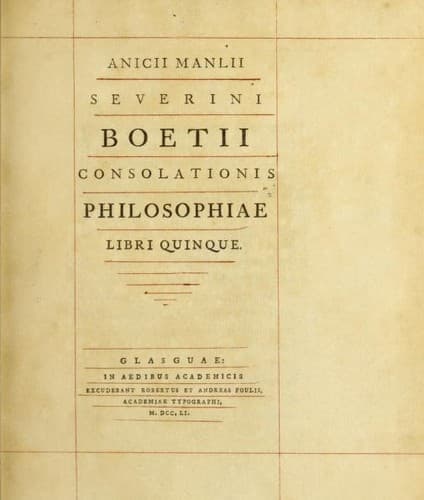
Chaucer's Translation of Boethius's "De Consolatione Philosophiae"Boethius
ReligionComparative
Chaucer's Translation of Boethius's "De Consolatione Philosophiae"
Boethius
Happiness; Philosophy and religion
++Evrus þe wynde aryueþ þe sayles of vlixes duc of þe
contre of narice. {and} hys wandryng shippes by þe 3480
see in to þe isle þere as Circe þe fayre goddesse douȝter
of þe sonne dwelleþ þat medlyþ to hir newe gestes
drynkes þat ben touched {and} maked wiþ enchau{n}tmentȝ.
{and} after þat hir hande myȝty of þe herbes 3484
had[de] chau{n}ged hir gestes i{n} to dyuerse maneres. þat
oon of hem is couered his face wiþ forme of a boor. þat
oþer is chau{n}ged in to a lyou{n} of þe contre of marmorike.
{and} his nayles {and} his teþe wexen.
[Sidenote: some into howling wolves, and others into Indian
tigers.]
¶ þat 3488
oþer of hem is newliche chaunged in to a wolf. {and}
howeliþ whan he wolde wepe. þat oþer goþ debonairly
in þe house as a tigre of Inde.
[Sidenote: But Mercury, the Arcadian god, rescued Ulysses from the
Circean charms. Yet his mariners, having drunk of her infected
drinks, were changed to swine, and fed on acorns.]
but al be it so þat þe
godhed of mercurie þat is cleped þe bride of arcadie haþ 3492
had mercie of þe duc vlixes byseged wiþ diu{er}se yueles
{and} haþ vnbounden hym fro þe pestilence of hys
oosteresse algates þe rowers {and} þe maryners hadden by
þis ydrawen in to hir mouþes {and} dronken þe wicked[e] 3496
drynkes þei þat were woxen swyne hadden by þis [[pg 123]]
chau{n}ged hire mete of brede forto ete acorns of ookes.
[Sidenote: All traces of the human form were lost, and they were
bereft of speech.]
non of hir lymes ne dwelliþ wiþ he{m} hoole. but
þei han lost þe voys {and} þe body.
[Sidenote: Their souls, unchanged, bewailed their dreadful fate.]
Oonly hir{e} þouȝt 3500
dwelleþ wiþ hem stable þ{a}t wepiþ {and} bywailiþ þe
monstruous chaungynge þat þei suffren.
[Sidenote: O most weak, are Circe’s powers compared with the
potency of vice, to transform the human shape!]
¶ O ouer lyȝt
hand. as who seiþ. ¶ O feble {and} lyȝt is þe hand of
Circes þe enchaunteresse þat chaungeþ þe bodies of folk 3504
in to bestes to regarde {and} to co{m}parisou{n} of mutac{i}ou{n}
þat is makid by vices.
[Sidenote: Circe’s herbs may change the body, but cannot touch the
mind, the inward strength of man.]
ne þe herbes of circes ne ben nat
myȝty. for al be it so þat þei may chau{n}gen þe lymes
of þe body. ¶ algates ȝit þei may nat chau{n}ge þe 3508
hertes. for wiþ inne is yhid þe strengþe {and} þe vigour
of me{n} in þe secre toure of hire hertys. þat is to seyn
þe strengþe of resou{n}.
[Sidenote: But vice is more potent than Circe’s poisonous charms.]
but þilke uenyms of vices to-drawen
a man to hem more myȝtily þan þe venym of 3512
circes.
Public-domain text, read in full here on John Shaqi.
Reviews
Reviews
No reviews yet
Be the first to share your thoughts on this work.
Elsewhere in the archive
Join the Discussion
Join the discussion
Sign in to leave a comment or review.
Sign InorCreate an account