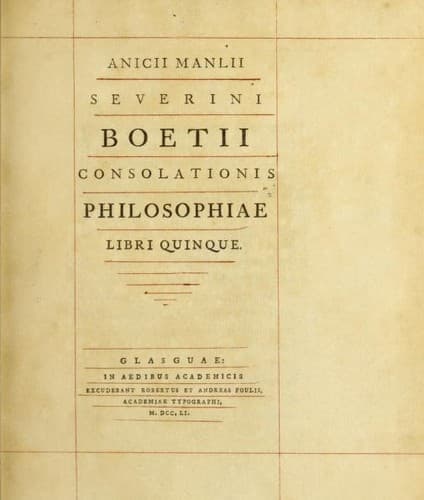
Chaucer's Translation of Boethius's "De Consolatione Philosophiae"Boethius
ReligionComparative
Chaucer's Translation of Boethius's "De Consolatione Philosophiae"
Boethius
Happiness; Philosophy and religion
riches of philosophy, poetry, and eloquence, must already have possessed
the intrepid calmness which he affected to seek. Suspense, the worst of
evils, was at length determined by the ministers of death, who executed,
and perhaps exceeded, the inhuman mandate of Theodoric. A strong cord
was fastened round the head of Boethius, and forcibly tightened till his
eyes almost started from their sockets; and some mercy may be discovered
in the milder torture of beating him with clubs till he expired. But his
genius survived to diffuse a ray of knowledge over the darkest ages of
the Latin world; the writings of the philosopher were translated by the
most glorious of the English kings, and the third emperor of the name of
Otho removed to a more honourable tomb the bones of a Catholic saint,
who, from his Arian persecutors, had acquired the honours of martyrdom
and the fame of miracles. In the last hours of Boethius, he derived some
comfort from the safety of his two sons, of his wife, and of his
father-in-law, the venerable Symmachus. But the grief of Symmachus was
indiscreet, and perhaps disrespectful; he had presumed to lament, he
might dare to revenge, the death of an injured friend. He was dragged in
chains from Rome to the palace of Ravenna; and the suspicions of
Theodoric could only be appeased by the blood of an innocent and aged
senator.--Gibbon’s _Decline and Fall_, 1838, vol. vii. p. 45-52 (without
the notes).
INDEX
_(Giving the first line of each Metre, the first words of each Prose,
and the corresponding page of the translation)._
Book Metre Prose Page
Public-domain text, read in full here on John Shaqi.
Reviews
Reviews
No reviews yet
Be the first to share your thoughts on this work.
Join the Discussion
Join the discussion
Sign in to leave a comment or review.
Sign InorCreate an account