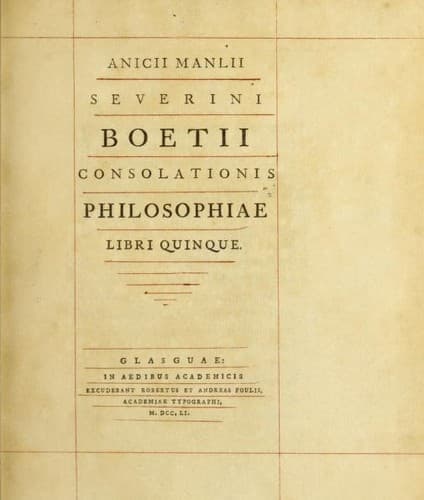
Chaucer's Translation of Boethius's "De Consolatione Philosophiae"Boethius
ReligionComparative
Chaucer's Translation of Boethius's "De Consolatione Philosophiae"
Boethius
Happiness; Philosophy and religion
“If Albinus be criminal,” exclaimed the orator, “the senate and myself
are all guilty of the same crime. If we are innocent, Albinus is equally
entitled to the protection of the laws.” These laws might not have
punished the simple and barren wish of an unattainable blessing; but
they would have shown less indulgence to the rash confession of
Boethius, that, had he known of a conspiracy, the tyrant never should.
The advocate of Albinus was soon involved in the danger and perhaps the
guilt of his client; their signature (which they denied as a forgery)
was affixed to the original address, inviting the emperor to deliver
Italy from the Goths; and three witnesses of honourable rank, perhaps of
infamous reputation, attested the treasonable designs of the Roman
patrician. Yet his innocence must be presumed, since he was deprived by
Theodoric of the means of justification, and rigorously confined in the
tower of Pavia, while the senate, at the distance of five hundred miles,
pronounced a sentence of confiscation and death against the most
illustrious of its members. At the command of the Barbarians, the occult
science of a philosopher was stigmatized with the names of sacrilege and
magic. A devout and dutiful attachment to the senate was condemned as
criminal by the trembling voices of the senators themselves; and their
ingratitude deserved the wish or prediction of Boethius, that, after
him, none should be found guilty of the same offence.
While Boethius, oppressed with fetters, expected each moment the
sentence or the stroke of death, he composed in the tower of Pavia the
_Consolation of Philosophy_; a golden volume not unworthy of the leisure
of Plato or Tully, but which claims incomparable merit from the
barbarism of the times and the situation of the author. The celestial
guide, whom he had so long invoked at Rome and Athens, now condescended
to illumine his dungeon, to revive his courage, and to pour into his
wounds her salutary balm. She taught him to compare his long prosperity
and his recent distress, and to conceive new hopes from the inconstancy
of fortune. Reason had informed him of the precarious condition of her
gifts; experience had satisfied him of their real value; he had enjoyed
them without guilt; he might resign them without a sigh, and calmly
disdain the impotent malice of his enemies, who had left him happiness,
since they had left him virtue. From the earth, Boethius ascended to
heaven in search of the SUPREME GOOD; explored the metaphysical
labyrinth of chance and destiny, of prescience and free-will, of time
and eternity; and generously attempted to reconcile the perfect
attributes of the Deity with the apparent disorders of his moral and
physical government. Such topics of consolation, so obvious, so vague,
or so abstruse, are ineffectual to subdue the feelings of human nature.
Yet the sense of misfortune may be diverted by the labour of thought;
and the sage who could artfully combine in the same work the various
Public-domain text, read in full here on John Shaqi.
Reviews
Reviews
No reviews yet
Be the first to share your thoughts on this work.
Join the Discussion
Join the discussion
Sign in to leave a comment or review.
Sign InorCreate an account