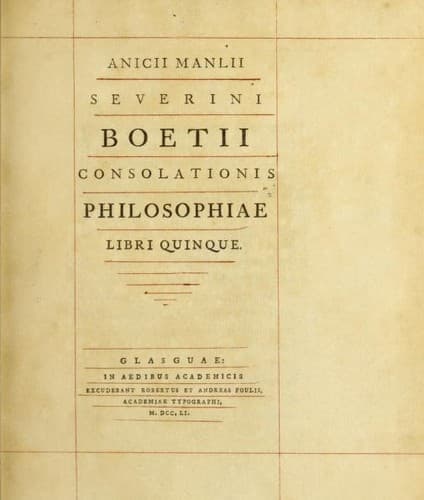
Chaucer's Translation of Boethius's "De Consolatione Philosophiae"Boethius
ReligionComparative
Chaucer's Translation of Boethius's "De Consolatione Philosophiae"
Boethius
Happiness; Philosophy and religion
[Sidenote: The wicked are more unhappy when they have accomplished
their evil designs than when they fail to do so.]
¶ For al be it so þ{a}t þis ne seme nat
credible þing p{er}auent{ur}e to so{m}me folk ȝit mot it
nedes be þat shrewes ben more wrecches {and} vnsely. 3532
whan þei may don {and} p{er}forme þat þei coueiten [than
yif they myhte nat complyssen þ{a}t they coueyten].
[Sidenote: If it is a miserable thing to will evil, it is a
greater unhappiness to have the power to execute it, without which
power the wicked desires would languish without effect.]
¶ For
yif so be þat it be wrecchednesse to wilne to don yuel[;]
þan is it more wrecchednesse to mowen don yuel. 3536
wiþ oute whiche moeuyng þe wrecched wille sholde
languisshe wiþ oute effecte.
[Sidenote: Since, then, each of these three things (_i. e._ the
will, the power, and the accomplishment of evil) hath its misery,
therefore a threefold wretchedness afflicts those who both will,
can, and do commit sin.]
¶ þan syn þat eueryche of
þise þinges haþ hys wrecchednesse. þat is to seyne wil
to done yuel. and moeuynge to done yuel. it mot nedes 3540
be. þat þei (shrewes) ben constreyned by þre vnselynesses
þat wolen {and} mowen {and} p{er}formen felonyes
{and} shrewednesses.
[Sidenote: _B._ I grant it--but still I wish the vicious were
without this misfortune.]
¶ I accorde me q{uo}d I. but I
desire gretely þat shrewes losten sone þilke vnselynesses. 3544
þat is to seyne þat shrewes were despoyled of moeuyng
to don yuel.
[Sidenote: _P._ They shall be despoiled of it sooner than you wish
perhaps, or than they themselves imagine.]
¶ so shulle{n} þei q{uo}d she.
[Sidenote: [* fol. 28.]]
sonnere
p{er}auenture þen þ{o}u woldest *or sonnere þen þei hem
self wenen to lakken mowynge to done yuel.
[Sidenote: In the narrow limits of this life, nothing, however
tardy it appears, can seem to an immortal soul to have a very long
duration.]
¶ For 3548
þere nis no þing so late in so short bou{n}des of þis lijf
þat is longe to abide. namelyche to a corage inmortel.
[Sidenote: The great hopes, and the subtle machinations of the
wicked, are often suddenly frustrated, by which an end is put to
their wickedness.]
Of whiche shrewes þe grete hope {and} þe heye co{m}passy{n}g{us}
of shrewednesse is often destroyed by a 3552
sodeyne ende or þei ben war. {and} þat þing establiþ to
shrewes þe ende of hir shrewednesse.
[Sidenote: If vice renders men wretched, the longer they are
vicious the longer must they be miserable.]
¶ For yif þat
shrewednesse makiþe wrecches. þan mot he nedes be
most wrecched þat lengest is a shrewe.
Public-domain text, read in full here on John Shaqi.
Reviews
Reviews
No reviews yet
Be the first to share your thoughts on this work.
Elsewhere in the archive
Join the Discussion
Join the discussion
Sign in to leave a comment or review.
Sign InorCreate an account