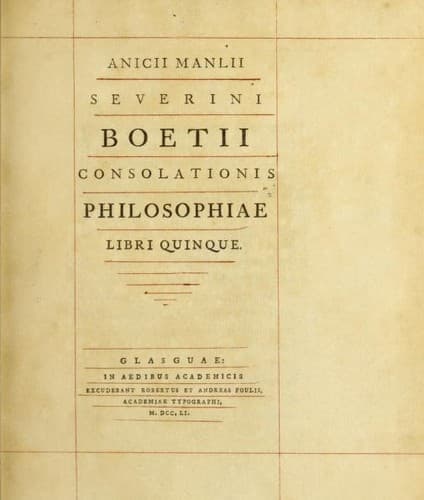
Chaucer's Translation of Boethius's "De Consolatione Philosophiae"Boethius
ReligionComparative
Chaucer's Translation of Boethius's "De Consolatione Philosophiae"
Boethius
Happiness; Philosophy and religion
++Who so þat ne knowe nat þe sterres of arctour
yto{ur}ned neye to þe souereyne contre or point.
þat is to seyne yto{ur}ned neye to þe souereyne pool of þe 3796
firmament {and} woot nat whi þe sterre boetes passeþ or
gaderiþ his wey[n]es. {and} drencheþ his late flaumbes in
þe see. {and} whi þat boetes þe sterre vnfoldiþ his ouer
swifte arisynges. þan shal he wo{n}dre{n} of þe lawe of þe 3800
heye eyre.
[Sidenote: The vulgar are alarmed when shadows terrestrial obscure
the moon’s brightness, causing the stars to be displayed.]
{and} eke if þat he ne knowe nat why þat þe
hornes of þe ful[le] moene waxen pale {and} infect by þe
bou{n}des of þe derke nyȝt ¶ and how þe moene dirk
{and} confuse discouereþ þe sterres. þat she had[de] [[pg 133]]
ycouered by hir clere visage.
[Sidenote: Thinking the eclipse the result of enchantment, they
sought to destroy the charms by the tinkling of brazen vessels or
cymbals.]
þe co{m}mune errour moeueþ 3805
folk {and} makiþ wery hir bacines of bras by þikke
strookes. þat is to seyne þat þer is a maner poeple þat
hyȝt[e] coribandes þat wenen þat whan þe moone is in 3808
þe eclips þat it be enchau{n}tid. and þerfore forto rescowe
þe moone þei betyn hire basines wiþ þikke strokes.
[Sidenote: Yet none marvel when the north-west wind renders the
sea tempestuous; nor when vast heaps of congealed snow are melted
by the warm rays of the sun, because the causes are apparent.]
¶ Ne no man ne wondreþ whan þe blastes of þe wynde
chorus betyn þe strondes of þe see by quakynge floodes. 3812
ne no man ne wondreþ whan þe weyȝte of þe snowe
yhardid by þe colde. is resolued by þe brennynge hete
of phebus þe sonne. ¶ For here seen men redyly þe
causes.
[Sidenote: Things whose causes are unknown disquiet the human
mind.]
[Sidenote: [* fol. 30.]]
but þe *causes yhid þat is to seye in heuene 3816
trouble þe brestes of men.
[Sidenote: The fickle mob stands amazed at every rare or sudden
phenomenon.]
¶ þe moeueable poeple is
a-stoned of alle þinges þat comen selde {and} sodeynely in
oure age.
[Sidenote: Fear and wonder, however, soon cease when ignorance
given place to certain knowledge.]
but yif þe troubly errour of oure ignora{n}ce
departid[e] from vs. so þat we wisten þe causes whi þat 3820
swiche þinges bitiden. certys þei sholde{n} cesse to seme
wondres.
Public-domain text, read in full here on John Shaqi.
Reviews
Reviews
No reviews yet
Be the first to share your thoughts on this work.
Elsewhere in the archive
Join the Discussion
Join the discussion
Sign in to leave a comment or review.
Sign InorCreate an account