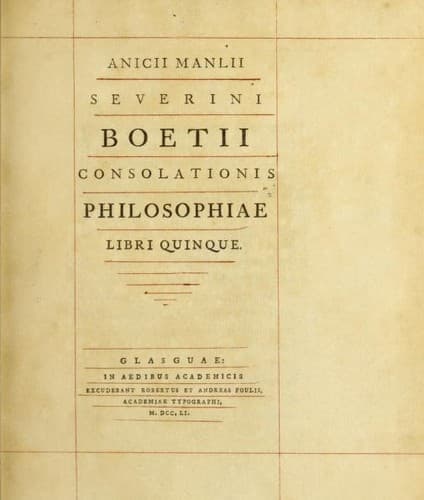
Chaucer's Translation of Boethius's "De Consolatione Philosophiae"Boethius
ReligionComparative
Chaucer's Translation of Boethius's "De Consolatione Philosophiae"
Boethius
Happiness; Philosophy and religion
[Sidenote: 3. Sudden chance. 4. Prescience of God, and divine
predestination. 5. Free-will.]
{and} of sodeyne hap. {and} of þe knowyng {and}
p{re}destinac{i}ou{n} deuine {and} of þe lyberte of fre wille. 3844
þe whiche þing þou þi self ap{er}ceiust wel of what weyȝt
þei ben. but for as mochel as þe knowynge of þise
þinges is a manere porc{i}ou{n} to þe medicine to þe. al be it
so þat I haue lytel tyme to don it.
[Sidenote: I will try to treat of these things:--]
ȝit naþeles I wole 3848
enforcen me to shewe somwhat of it. ¶ but al þouȝ
þe norissinges of dite of musike deliteþ þe þow most
suffren. {and} forberen a litel of þilk delite while þat I
weue (contexo) to þe resou{n}s yknyt by ordre ¶ As it likeþ 3852
to þe q{uo}d I so do.
[Sidenote: Resuming her discourse as from a new principle,
Philosophy argued as follows:--]
¶ þo spak she ryȝt a[s] by an oþer
bygynnyn[ge] {and} seide þus.
[Sidenote: The generation of all things, every progression of
things liable to change, and everything that moveth, derive their
causes, order, and form from the immutability of the divine
understanding.]
¶ þe enge{n}drynge of alle
þinges q{uo}d she {and} alle þe progressiou{n}s of muuable
nat{ur}e. {and} alle þ{a}t moeueþ in any manere takiþ hys 3856
causes. hys ordre. {and} hys formes. of þe stablenesse of þe
deuyne þouȝt
[Sidenote: Providence directs all things by a variety of means.]
[{and} thilke deuyne thowht] þat is yset {and}
put in þe toure. þat is to seyne in þe heyȝt of þe simplicite
of god. stablisiþ many manere gyses to þinges þat 3860
ben to don.
[Sidenote: These means, referred only to the divine intelligence,
are called Providence; but when contemplated in relation to the
things which receive motion and order from them, are called
Destiny.]
¶ þe whiche manere whan þat men loken
it i{n} þilke pure clerenesse of þe deuyne i{n}telligence. it
is ycleped p{ur}ueaunce ¶ but whan þilke manere is referred
by me{n} to þinges þat it moeueþ {and} disponeþ þan [[pg 135]]
of olde men. it was cleped destine.
Public-domain text, read in full here on John Shaqi.
Reviews
Reviews
No reviews yet
Be the first to share your thoughts on this work.
Elsewhere in the archive
Join the Discussion
Join the discussion
Sign in to leave a comment or review.
Sign InorCreate an account