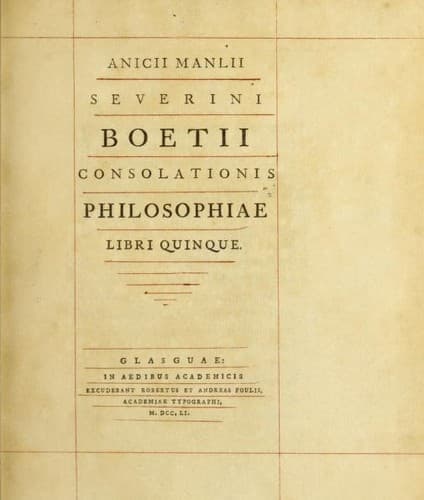
Chaucer's Translation of Boethius's "De Consolatione Philosophiae"Boethius
ReligionComparative
Chaucer's Translation of Boethius's "De Consolatione Philosophiae"
Boethius
Happiness; Philosophy and religion
Originally printed by
Richard Clay & Sons Ltd., London and Bungay
and now reprinted lithographically in Great Britain
at the University Press, Oxford
by Vivian Ridler
Printer to the University
INTRODUCTION.
When master hands like those of Gibbon and Hallam have sketched the life
of _Boethius_, it is well that no meaner man should attempt to mar their
pictures. They drew, perhaps, the most touching scene in Middle-age
literary history,--the just man in prison, awaiting death, consoled by
the Philosophy that had been his light in life, and handing down to
posterity for their comfort and strength the presence of her whose
silver rays had been his guide as well under the stars of Fortune as the
mirk of Fate. With Milton in his dark days, Boece in prison could say,--
‘I argue not
Against Heaven’s hand or will, nor bate a jot
Of heart or hope; but still bear up and steer
Right onward. What supports me, dost thou ask?
The conscience, friend, to have lost them overplied
In liberty’s defence, my noble task,
Of which all Europe rings from side to side.’
For, indeed, the echoes of Boethius, Boethius, rang out loud from every
corner of European Literature. An Alfred awoke them in England, a
Chaucer, a Caxton would not let them die; an Elizabeth revived them
among the glorious music of her reign.[I-1] To us, though far off, they
come with a sweet sound. ‘The angelic’ Thomas Aquinas commented on him,
and many others followed the saint’s steps. Dante read him, though,
strange to say, he speaks of the Consolation as ‘a book not known by
many.’[I-2] Belgium had her translations--both Flemish[I-3] and
French[I-4]; Germany hers,[I-5] France hers,[I-6] Italy hers.[I-7] The
Latin editors are too numerous to be catalogued here, and manuscripts
abound in all our great libraries.
No philosopher was so bone of the bone and flesh of the flesh of
Middle-age writers as Boethius. Take up what writer you will, and you
find not only the sentiments, but the very words of the distinguished
old Roman. And surely we who read him in Chaucer’s tongue, will not
refuse to say that his full-circling meed of glory was other than
deserved. Nor can we marvel that at the end of our great poet’s life, he
was glad that he had swelled the chorus of Boethius’ praise; and ‘of the
translacioun of Boece de Consolacioun,’ thanked ‘oure Lord Ihesu Crist
and his moder, and alle the seintes in heuen.’
The impression made by Boethius on Chaucer was evidently very deep. Not
only did he translate him directly, as in the present work, but he read
his beloved original over and over again, as witness the following list,
incomplete of course, of passages from Chaucer’s poems translated more
or less literally from the _De Consolatione_:
Public-domain text, read in full here on John Shaqi.
Reviews
Reviews
No reviews yet
Be the first to share your thoughts on this work.
Join the Discussion
Join the discussion
Sign in to leave a comment or review.
Sign InorCreate an account