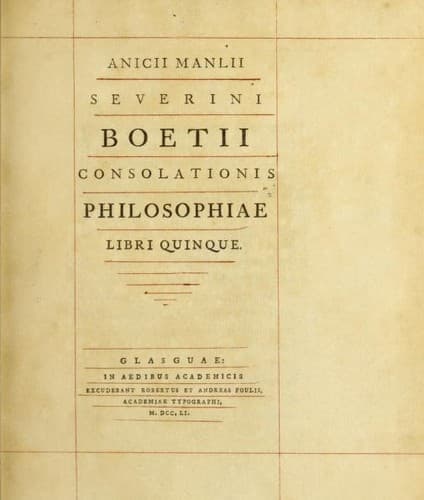
Chaucer's Translation of Boethius's "De Consolatione Philosophiae" — John Shaqi
Chaucer's Translation of Boethius's "De Consolatione Philosophiae"Boethius
ReligionComparative
Chaucer's Translation of Boethius's "De Consolatione Philosophiae"
Boethius
Happiness; Philosophy and religion
[Footnote I-1: Other translations are by John Walton of Osney, in
verse, in 1410 (Reg. MS. 18, A 13), first printed at Tavistock in
1525, and to be edited some time or other for the E.E.T.S. An
anonymous prose version in the Bodleian. George Coluile, alias
Coldewel, 1556; J. T. 1609; H. Conningesbye, 1664; Lord Preston,
1695, 1712; W. Causton, 1730; Redpath, 1785; R. Duncan, 1789;
anon. 1792 (Lowndes).]
[Footnote I-2: Dante, in his _Convito_, says, “Misimi a legger
quello _non conosciuto da molti_ libro di Boezio, nel quale
captivo e discacciato consolato s’avea.”]
[Footnote I-3: Printed at Ghent, 1485.]
[Footnote I-4: By Reynier de Seinct Trudon, printed at Bruges,
1477.]
[Footnote I-5: An old version of the 11th cent., printed by Graff,
and a modern one printed at Nuremberg, 1473.]
[Footnote I-6: By Jean de Méung, printed at Paris, 1494.]
[Footnote I-7: By Varchi, printed at Florence, 1551; Parma, 1798.]
I. LOVE.
Wost thou nat wel the olde clerkes sawe,
That who schal yeve a lover eny lawe,
Love is a grettere lawe, by my pan,
Then may be yeve to (of) eny erthly man?
(_Knightes Tale, Aldine Series_, vol. ii. p. 36, 37.)
But what is he þat may ȝeue a lawe to loueres. loue is a gretter
lawe and a strengere to hym self þan any lawe þat men may ȝeuen.
(_Chaucer’s Prose Translation_, p. 108.)
_Quis legem det amantibus?
Major lex amor est sibi._
(Boeth., lib. iii. met. 12.)
II. A DRUNKEN MAN.
A dronke man wot wel he hath an hous,
But he not[I-8] which the righte wey is thider.
(_Knightes Tale_, vol. ii. p. 39.)
_Ryȝt as a dronke man not nat[I-9] by whiche paþe he may retourne
home to hys house._
(Chaucer’s Trans., p. 67.)
_Sed velut ebrius, domum quo tramite revertatur, ignorat._
(Boeth., lib. iii. pr. 2.)
[Footnote I-8: The Harl. MS. reads _not nat_, to the confusion of
the metre.]
[Footnote I-9: = ne wot nat = knows not.]
III. THE CHAIN OF LOVE.
The firste moevere of the cause above,
Whan he first made the fayre cheyne of love,
Gret was theffect, and heigh was his entente;
Wel wist he why, and what therof he mente;
_For with that faire cheyne of love he bond
The fyr, the watir, the eyr, and eek the lond
In certeyn boundes, that they may not flee._
(_Knightes Tale_, p. 92.)
Public-domain text, read in full here on John Shaqi.
Reviews
Reviews
No reviews yet
Be the first to share your thoughts on this work.
Join the Discussion
Join the discussion
Sign in to leave a comment or review.
Sign InorCreate an account