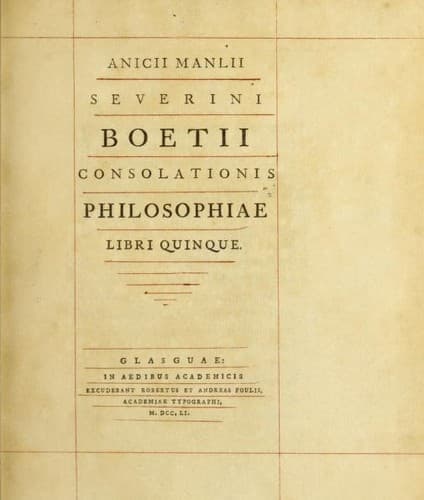
Chaucer's Translation of Boethius's "De Consolatione Philosophiae"Boethius
ReligionComparative
Chaucer's Translation of Boethius's "De Consolatione Philosophiae"
Boethius
Happiness; Philosophy and religion
[Headnote:
DESTINY RULES NATURE.]
[Sidenote: And if we suppose that the thing in question is joined
to the stability of the supreme mind, it then becomes immovable,
and is beyond the necessity and power of destiny.]
¶ and if þe þinge cleueþ to þe stedfastnesse 3928
of þe þouȝt of god. {and} be wiþ oute moeuyng certys it
so{ur}mounteþ þe necessite of destyne.
[Sidenote: As reasoning is to the understanding, as that which is
produced to that which exists of itself, as time to eternity, as
the circle to the centre, so is the movable order of Fate to the
stable simplicity of Providence.]
þan ryȝt swiche
comparisou{n} as [it] is of skilynge to vndirstondyng {and}
of þing þat is engendred to þing þat is. {and} of tyme to 3932
eternite. {and} of þe cercle to þe Centre. ryȝt so is þe
ordre of moeueable destine to þe stable symplicite of
p{ur}ueaunce.
[Sidenote: Destiny rules nature.]
¶ þilke ordinaunce moeueþ þe heuene
{and} þe sterres {and} attempreþ þe elymentȝ to gider 3936
amonges hem self. {and} t{ra}nsformeþ hem by enterchau{n}gable
mutac{i}ou{n}. ¶ and þilke same ordre neweþ
aȝein alle þinges growyng {and} fallyng a-doune by sembleables
p{ro}gressiou{n}s of seedes {and} of sexes. þat is 3940
to sein. male {and} female.
[Sidenote: It controls the actions of men by an indissoluble chain
of causes, and is, like their origin, immutable.]
and þis ilke ordre co{n}streyneþ
þe fortunes {and} þe dedes of men by a bonde of causes
nat able to ben vnbou{n}den (indissolubili). þe whiche
destinal causes whanne þei passen oute fro þe bygynnynges 3944
of þe vnmoeueable purueaunce it mot nedes
be þat þei ne be nat mutable.
[Sidenote: Thus, then, are all things well conducted, since that
invariable order of cause has its origin in the simplicity of the
Divine mind, and by its inherent immutability exercises a
restraint upon mutable things, and preserves them from
irregularity.]
[Sidenote: [* fol. 31.]]
{and} þus ben þe þinges ful
wel ygouerned. yif þat þe symplicite dwelly{n}ge *in þe
deuyne þouȝt sheweþ furþe þe ordre of causes. vnable to 3948
be I-bowed. {and} þis ordre constreyneþ by hys p{ro}pre
stablete þe moeueable þinges. or ellys þei sholde fleten
folily
[Sidenote: To those who understand not this order, things appear
confused--nevertheless, the proper condition of all things directs
and inclines it to their true good.]
for whiche it is þat alle þinges semen to be confus
{and} trouble to vs men. for we ne mowe nat co{n}sider{e} 3952
þilke ordinaunce. ¶ Naþeles þe p{ro}pre manere of
euery þing dressynge hem to goode disponit hem alle.
Public-domain text, read in full here on John Shaqi.
Reviews
Reviews
No reviews yet
Be the first to share your thoughts on this work.
Elsewhere in the archive
Join the Discussion
Join the discussion
Sign in to leave a comment or review.
Sign InorCreate an account