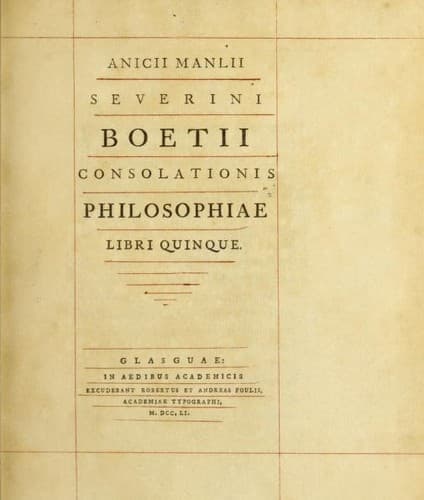
Chaucer's Translation of Boethius's "De Consolatione Philosophiae"Boethius
ReligionComparative
Chaucer's Translation of Boethius's "De Consolatione Philosophiae"
Boethius
Happiness; Philosophy and religion
[Headnote:
GOD THE SOUL’S PHYSICIAN.]
whan god þat alle knoweþ doþ swiche þing. of whiche 3996
þing [þat] vnknowyng folk ben astoned
[Sidenote: But, now let us notice a few things concerning the
depth of the Divine knowledge which human reason may comprehend.]
but forto constreine
as who seiþ ¶ But forto co{m}prehende {and} telle
a fewe þinges of þe deuyne depnesse þe whiche þat mans
resou{n} may vnderstonde.
[Sidenote: The man you deem just, may appear otherwise to the
omniscient eye of Providence.]
¶ þilk man þat þou wenest 4000
to ben ryȝt Iuste {and} ryȝt kepyng of eq{u}ite. þe contrarie
of þat semeþ to þe deuyne p{ur}ueaunce þat al woot.
¶ And lucan my familier telleþ þat þe victories cause
liked[e] to þe goddes {and} causes ouercomen liked[e] to 4004
cato{u}n.
[Sidenote: When you see apparent irregularities--unexpected and
unwished for--deem them to be rightly done.]
þan what so euer þou mayst seen þat is don in
þis [world] vnhoped or vnwened. certys it is þe ryȝt[e]
ordre of þinges. but as to þi wicked[e] oppiniou{n} it is a
co{n}fusiou{n}.
[Sidenote: Let us suppose a man so well behaved, as to be approved
of God and man--but not endowed with firmness of mind, so that the
reverses of fortune will cause him to forgo his probity, since
with it he cannot retain his prosperity.]
but I suppose þat som man be so wel yþewed. 4008
þat þe deuyne Iugement {and} þe Iugeme{n}t of mankynde
accorden hem to gidre of hym. but he is so vnstedfast
of corage [þat] yif any aduersite come to hym he wolde
for-leten p{er}auenture to continue i{n}nocence by þe 4012
whiche he ne may nat wiþholden fortune.
[Sidenote: A wise Providence, knowing that adversity might destroy
this man’s integrity, averts from him that adversity which he is
not able to sustain.]
[Sidenote: [* fol. 31 _b_.]]
¶ þan þe
wise dispensac{i}ou{n} of god spareþ hym þe whiche
man{er}e adu{er}site *myȝt[e] enpeyren. ¶ For þat god
wil nat suffren hym to trauaile. to whom þat trauayl 4016
nis nat couenable.
[Sidenote: Another man is thoroughly virtuous, and approaches to
the purity of the deity--him Providence deems it an injustice to
oppress by adversity, and therefore exempts him even from bodily
disease.]
¶ An oþ{er} man is p{er}fit in alle
uertues. {and} is an holy man {and} neye to god so þat þe
p{ur}ueaunce of god wolde demen þat it were a felony
þat he were touched wiþ any aduersites. so þat he ne 4020
wil nat suffre þat swiche a man be moeued wiþ any [[pg 140]]
manere maladie. ¶ But so as seide a philosophre [the
moore excellent by me]. þe adu{er}sites comen nat (he
seide in grec[;]) þere þ{a}t uertues han edified þe bodie 4024
of þe holy man.
Public-domain text, read in full here on John Shaqi.
Reviews
Reviews
No reviews yet
Be the first to share your thoughts on this work.
Elsewhere in the archive
Join the Discussion
Join the discussion
Sign in to leave a comment or review.
Sign InorCreate an account