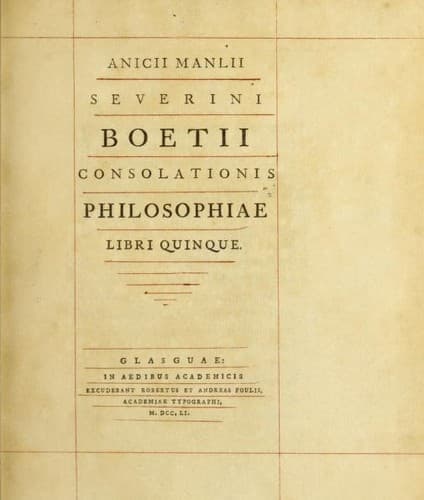
Chaucer's Translation of Boethius's "De Consolatione Philosophiae"Boethius
ReligionComparative
Chaucer's Translation of Boethius's "De Consolatione Philosophiae"
Boethius
Happiness; Philosophy and religion
[Linenotes:
4437 _harde_--hard
4445 _haþ_--MS. haþ{e}
4446 _whiche_--which
4450 _wille_--wil
_whiche_--which þ{a}t
4451 _haþ_--MS. haþe
4453 _stedfast_--stydefast
4454-55 _þinge_--thing
4455 _on_--of
4456 _þilk_--thilke
4458 _whiche_--which
4459 _knot_--knotte
4461 _come_--comyn
_haþ_--MS. haþe
4464 _hyd_--MS. hydde, C. hidde
4466 [_nat_]--from C.
4467-8 [_but----yporueyid_]--from C.
4471 _þinges_--thing
4477 _haþ_--MS. haþe
4480-82 _soþe_--soth
4486 _soþe_--sooth
4487 _soþe_--soth
4488 _soþe_--sooth
4489 _soþe comeþ_--sooth comth
[_þe_]--from C.
4490 _comune_--MS. comme, C. comune
4493 _come_--comyn
4494 _to_--omitted
4494-95 _purueid_--MS. p{ur}ueide, C. p{ur}ueyid
4498 [_.s._]--from C.
4499 _fredome_--freedom
4500 _wille_--wil
4501 [_certes_]--from C.
4504 _purueiþ_--MS. p{ur}ueiþe
[_the_]--from C.
4506 _bitiden_--bytydden
_som tyme_--whilom
4509 _o_--a
_self_--selue
4510 _þinge_--thing
4511 _þilk[e]_--thilke
4513 _þinge_--thing
4514 _last[e]_--laste
4515 _nys_--is]
[Headnote:
FREEDOM OF THE HUMAN WILL.]
[Sidenote: If, therefore, a thing be so to happen that the event
of it is neither necessary nor certain, how can any one foresee
what is to happen?]
¶ wher-fore yif any þing be so to comen so þat
þe bytydynge of it ne be nat certeyne ne necessarie.
¶ who may weten [byforn] þ{a}t þilke þing is to come.
[Sidenote: For as pure knowledge has no element in it of
falsehood, so what is comprehended by true knowledge cannot be
otherwise than as comprehended.]
¶ For ryȝt as science ne may nat be medelyd wiþ falsnesse. 4520
as who seiþ þat yif I woot a þing. it ne may nat
be fals þat I ne woot it. ¶ Ryȝt so þilk þing þat
is conceyued by science ne may [nat] ben noon
oþ{er} weyes þan [as] it is conceiued.
[Sidenote: Hence it is that true knowledge cannot err, because
everything must precisely be what true knowledge perceives it to
be.]
For þat is þe cause 4524
whi þat science wa{n}tiþ lesynge. as who seiþ. whi þat
witynge ne receyueþ nat lesynge of þat it woot. ¶ For
it byhoueþ by necessite þat euery þi{n}ge [be] ryȝt as science
co{m}p{re}hendiþ it to be.
[Sidenote: What follows, then? How does God foreknow these
uncertain contingencies?]
what shal I þan sein. ¶ In 4528
whiche man{er}e knoweþ god byforn þe þinges to comen.
¶ yif þei ne be nat certeyne. [[pg 157]]
[Sidenote: For if he thinks that a thing will inevitably happen,
which possibly may not, he is deceived--but this is sheer
blasphemy.]
¶ For yif þat he deme
þat þei ben to comen vneschewably.
[Sidenote: [* fol. 35 _b_.]]
Public-domain text, read in full here on John Shaqi.
Reviews
Reviews
No reviews yet
Be the first to share your thoughts on this work.
Elsewhere in the archive
Join the Discussion
Join the discussion
Sign in to leave a comment or review.
Sign InorCreate an account