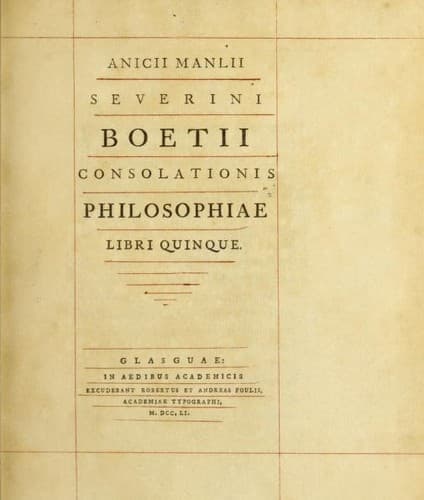
Chaucer's Translation of Boethius's "De Consolatione Philosophiae"Boethius
ReligionComparative
Chaucer's Translation of Boethius's "De Consolatione Philosophiae"
Boethius
Happiness; Philosophy and religion
[Linenotes:
4518 _it_--hit
4519 [_byforn_]--from C.
4522 _fals_--false
4523 [_nat_]--from C.
_ben_--MS. by, C. ben
4524 _þan [as] it is_--MS. þan it is be
4527 [_be_]--from C.
4529 _whiche_--which
4534 _mouþe_--Mowth
4536 _shulle_--shullyn
_wit[e]_--wite
4538 _don_--MS. done, C. y-doon
4543 _moche_--mochel
_worþe_--worth
4549 _haþ_--MS. haþe
4550 _whiche_--which
4551 _mankynde_--man-kynd
4554 [_this_]--from C.
4555 _grauntid_--ygraunted]
[Headnote:
FATE UNDER THE CONTROL OF PROVIDENCE.]
¶ For in ydel ben þer þan p{ur}posed and byhyȝt medes
of goode folk. {and} peynes to badde folk. syn þat no
moeuynge of free corage uoluntarie ne haþ nat deserued 4560
hem. þat is to seyn neiþer mede nor peyne.
[Sidenote: Rewards and punishments now deemed just and equitable,
will be considered most unjust, when, it is allowed, that mankind
are not prompted by any will of their own, to either virtue or
vice, but in all their actions are impelled by a fatal necessity.]
¶ And it
sholde seme þan þat þilke þinge is alþer worste whiche
þat is nowe demed. for alþ{er} moste iuste {and} moste [[pg 158]]
ryȝtful. þat is to seyn þat shrewes ben punyssed. or 4564
ellys þ{a}t good[e] folk ben ygerdoned. þe whiche folk
syn þat þe p{ro}pre wille [ne] sent hem nat to þ{a}t oon ne
to þat oþer. þat is to seyn. neþer to good[e] ne to
harme. but constreineþ hem certeyne necessite of þinges 4568
to comen.
[Sidenote: Nor would there be such things as virtue or vice, but
such a medley of the one and the other as would be productive of
the greatest confusion.]
¶ þanne ne sholle{n} þer neuer ben ne neuer
weren vice ne vertue. but it sholde raþer ben co{n}fusiou{n}
of alle desertes medlid wiþoute discresiou{n}. ¶ And
ȝitte þer folweþ an oþer i{n}co{n}uenient of þe whiche þer 4572
ne may ben þouȝt ne more felonous ne more wikke.
[Sidenote: And from this it will follow--that since all order
comes of Divine Providence, and that there is no freedom of the
human will, that also our vices must be referred to the author of
all good--which is a most impious opinion.]
{and} þat is þis þat so as þe ordre of þinges is yledd {and}
comeþ of þe purueaunce of god. ne þat no þing nis
leueful to þe conseils of mankynde. as who seiþ þat 4576
men han no power to done no þing. ne wilne no þing.
þan folweþ it þat oure vices ben refferred to þe mak[er]e
of alle good. as who seiþ þan folweþ it. þat god auȝt[e]
han þe blame of oure vices. syn he co{n}streiniþ by 4580
necessite to don vices.
[Sidenote: Then is it useless to hope for anything from God, or to
pray to him.]
þan nis þer no resou{n} to han
hopen in god. ne forto p{re}ien to god.
Public-domain text, read in full here on John Shaqi.
Reviews
Reviews
No reviews yet
Be the first to share your thoughts on this work.
Elsewhere in the archive
Join the Discussion
Join the discussion
Sign in to leave a comment or review.
Sign InorCreate an account