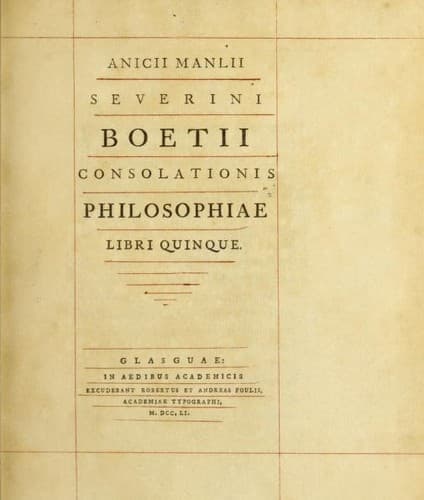
Chaucer's Translation of Boethius's "De Consolatione Philosophiae"Boethius
ReligionComparative
Chaucer's Translation of Boethius's "De Consolatione Philosophiae"
Boethius
Happiness; Philosophy and religion
woot it ouȝt þilke þinges
þat it anguissous desireþ to knowe. as who seiþ nay. [[pg 160]]
¶ For no man ne trauaileþ forto witen þinges þat he woot. 4624
{and} þerfore þe texte seiþ þus. ¶ [_Glosa_] Si eni{m} a{n}i{m}a
ignorat istas subtiles co{n}nexiones. r{espo}nde. vn{de} est
q{uo}d desiderat scire cu{m} nil ignotu{m} possit desiderare.
¶ But who traua[i]leþ to wyten þinges y-knowe.
[Sidenote: If he knows them not, what does he so blindly seek?]
and yif 4628
þat he ne knoweþ hem nat. what sekiþ þilke blynde
þouȝt.
[Sidenote: Who wishes for things he hath never known?]
what is he þat desireþ any þinge of whiche he
woot ryȝt nat. as who seiþ who so desiriþ any þing
nedis som what he knoweþ of it. or ellys he ne couþe 4632
nat desire it. or who may folwen þinges þat ne ben nat
ywist
[Sidenote: Or if he seek, where shall he find them? Or if he find,
how shall he be sure that he has found what he sought for?]
¶ and þouȝ [þ{a}t] he seke þo þinges where shal
he fynde{n} hem. what wyȝt þat is al vnknowynge {and}
ignoraunt may knowe þe forme þat is yfounde.
[Sidenote: The pure soul that sees the divine thought, knows all
the secret chains of things.]
¶ But 4636
whan þe soule byholdeþ {and} seeþ þe heye þouȝt. þat is
to seyn god. þan knoweþ it to-gidre þe so{m}me {and} þe
singularites. þat is to seyn þe p{r}inciples {and} eueryche
by hym self.
[Sidenote: Yet, though now hidden in its fleshly members, it hath
some remembrance of its pure state--it retains the sums of things,
but has lost their particulars.]
¶ But now while þe soule is hidd in þe 4640
cloude {and} in þe derknesse of þe membris of þe body.
it ne haþ nat al forȝeten it selfe. but it wiþholdeþ þe
so{m}me of þinges {and} lesiþ þe singularites.
[Sidenote: He who seeks truth is not in either circumstance
(_i. e._ seeking for what he knows or knows not), he knoweth not
all things, nor hath he wholly forgotten all.]
þan who so
þat sekeþ soþenesse. he nis in neiþ{er} nouþir habit. for 4644
he not nat alle ne he ne haþ nat alle for-ȝeten.
[Sidenote: But he ponders on what he knows, that he may add those
things that he hath forgotten to those that he retains.]
¶ But
ȝitte hym remembriþ þe so{m}me of þinges þat he wiþholdeþ
{and} axeþ cou{n}seil {and} tretiþ depelyche þi{n}ges
ysein byforne. [_Glosa_] þat is to sein þe grete so{m}me in 4648
hys mynde. [_textus_] so þat he mowe adden þe p{ar}ties
þat he haþ forȝeten. to þilke þat he haþ wiþholden.
Public-domain text, read in full here on John Shaqi.
Reviews
Reviews
No reviews yet
Be the first to share your thoughts on this work.
Elsewhere in the archive
Join the Discussion
Join the discussion
Sign in to leave a comment or review.
Sign InorCreate an account