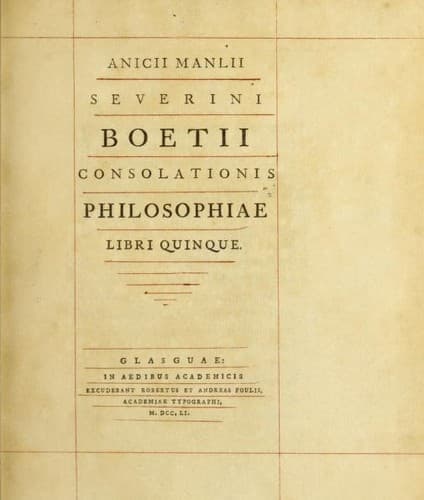
Chaucer's Translation of Boethius's "De Consolatione Philosophiae"Boethius
ReligionComparative
Chaucer's Translation of Boethius's "De Consolatione Philosophiae"
Boethius
Happiness; Philosophy and religion
[Sidenote: The assertion that nothing happens but by necessity,
must be proved by arguments drawn from causes connected and
agreeing with this necessity, and not from signs or foreign
causes.]
¶ But certys it is nowe certeyne þat þe preue of þis 4708
susteniþ by stedfast resou{n} ne shal nat ben ladd ne
p{ro}ued by signes ne by argumentys ytaken fro wiþ oute.
but by causes couenable {and} necessarie ¶ But þou
mayst sein how may it be þat þe þinges ne bitiden nat 4712
þat ben ypurueyed to comen. but certys ryȝt as we [[pg 163]]
trowen þat þo þinges whiche þat þe p{ur}ueau{n}ce woot byforn
to comen. ne ben nat to bitiden. but [þ{a}t] ne sholde
we nat demen. but raþer al þouȝ [þat] þei schal bitiden. 4716
ȝit ne haue þei no necessite of hire kynde to bitiden.
{and} þis maist þou lyȝtly ap{er}ceyue{n} by þis þat I shal
seyn.
[Sidenote: We see many things when they are done before our eyes;
such as a charioteer driving his chariot, and other things of like
nature.]
but we seen many þinges whan þei ben don byforn
oure eyen ryȝt as men seen þe karter worken in þe 4720
to{ur}nynge {and} in attempryng or in adressy{n}g of hys
kartes or chariottes. ¶ and by þis manere as who seiþ
mayst þou vnd{er}sto{n}de of alle manere oþir werkeme{n}.
[Sidenote: Now, is there any necessity which compels these things
to be done?]
¶ Is þere þanne any necessite as who seiþ in oure lokynge 4724
[þ{a}t] constreineþ or compelliþ any of þilke þinges
to ben don so.
[Sidenote: _B._ No. For if all things were moved by
compulsion--the efforts of art would be vain and fruitless.]
b. nay q{uo}d I ¶ For in ydel {and} in
veyne were alle þe effect of crafte yif þat alle þinges
weren moeued by constreynynge. þat is to seyn by constreynynge 4728
of oure eyen or of oure syȝt.
[Sidenote: _P._ The things, then, which are done are under no
necessity that they should be done; then first before they were
done, they were under no necessity of coming to pass; wherefore
some things happen, the event of which is unconstrained by
necessity.]
_P._ þise þi{n}g{us}
þan q{uo}d she þat whan men don hem ne han non
necessite þat men don hem. eke þo same þinges first or
þei be don. þei ben to comen wiþ out necessite.
[Sidenote: [* fol. 37.]]
for whi 4732
þer ben so{m}me þinges to bytide of whiche þe endys
{and} þe bitidynges of hem ben absolut *{and} quit of alle
necessite.
[Sidenote: These things therefore, although foreknown, have free
events: for as the knowledge of present things imposes no
necessity upon things which are now done, so neither does the
foreknowledge of futurities necessitate the things which are to
come.]
Public-domain text, read in full here on John Shaqi.
Reviews
Reviews
No reviews yet
Be the first to share your thoughts on this work.
Elsewhere in the archive
Join the Discussion
Join the discussion
Sign in to leave a comment or review.
Sign InorCreate an account