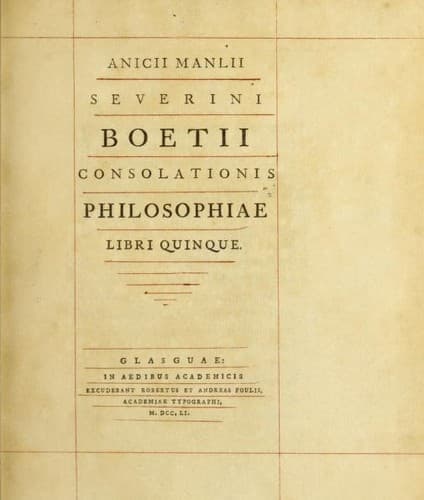
Chaucer's Translation of Boethius's "De Consolatione Philosophiae"Boethius
ReligionComparative
Chaucer's Translation of Boethius's "De Consolatione Philosophiae"
Boethius
Happiness; Philosophy and religion
[Sidenote: This faculty of comprehending and seeing all things as
present, God does not receive from the issue of futurities, but
from the simplicity of his own nature.]
and þis p{re}sence to co{m}p{re}henden
{and} to sen alle þinges. god ne haþ nat take{n} it of þe
bitydynge of þinges forto come. but of hys p{ro}pre symplicite.
[Linenotes:
5169 _soþenesse_--sothnesse
5170 _chaungen_--chaunge
5173 _syȝt_--syhte
5175 _wille_--wyl
5177 _wol_--wole
5179 _enterchaunge_--MS. enterchau{n}gyng, C. entrechau{n}ge
5181 _hys_--hise
5182 _somme_ (1)--su{m}
_somme_ (2)--som
5183 _syȝt_--syhte
5184 _to-forne_--to-forn
5186 [_so_]--from C.
5187 [_as_]--from C.
5188 _comiþ_--comth
5190 _haþ_--MS. haþe]
[Headnote:
AN ANSWER TO FORMER OBJECTIONS.]
[Sidenote: Here, then, is an answer to your former objection--that
it is folly to think that our future actions and events are the
causes of the prescience of God.]
¶ and her by is assoiled þilke þing þat þou 5192
puttest a litel her byforne. þat is to seyne þat it is vnworþi
þinge to seyn þat oure futures ȝeuen cause of þe
science of god
[Sidenote: For the Divine mind, embracing and comprehending all
things by a present knowledge, plans and directs all things and is
not dependent upon futurity.]
[Sidenote: [* fol. 41 _b_.]]
¶ For c{er}tys *þis strengþe of þe deuyne
science whiche þat enbraceþ alle þinge by his p{re}sentarie 5196
knowynge establisseþ manere to alle þi{n}g{us} {and} it
ne awiþ nat to lattere þinges.
[Sidenote: Since no necessity is imposed upon things by the Divine
prescience, there remains to men an inviolable freedom of will.]
{and} syn þat þise þinges
ben þus. þat is to seyn syn þat necessite nis nat in
þinges by þe deuyne p{re}science. þan is þer fredom of 5200
arbitre. þat dwelleþ hool {and} vnwemmed to mortal men.
[Sidenote: And those laws are just which assign rewards and
punishments to men possessing free-will.]
ne þe lawes ne p{ur}pose nat wikkedly meedes {and} peynes
to þe willynges of men þat ben vnbounde {and} quit of
alle necessite.
[Sidenote: Moreover, God, who sits on high, foreknows all things,
and the eternal presence of his knowledge concurs with the future
quality of our actions, dispensing rewards to good and punishments
to evil men.]
¶ And god byholder {and} forwiter of 5204
alle þinges dwelliþ aboue {and} þe p{re}sent eternite of hys
syȝt renneþ alwey wiþ þe dyuerse qualite of oure dedes
dispe{n}syng {and} ordeynynge medes to good[e] men. {and}
tourmentȝ to wicked men.
[Sidenote: Nor are our hopes and prayers reposed in, and addressed
to God in vain, which when they are sincere cannot be
inefficacious nor unsuccessful.]
Public-domain text, read in full here on John Shaqi.
Reviews
Reviews
No reviews yet
Be the first to share your thoughts on this work.
Elsewhere in the archive
Join the Discussion
Join the discussion
Sign in to leave a comment or review.
Sign InorCreate an account