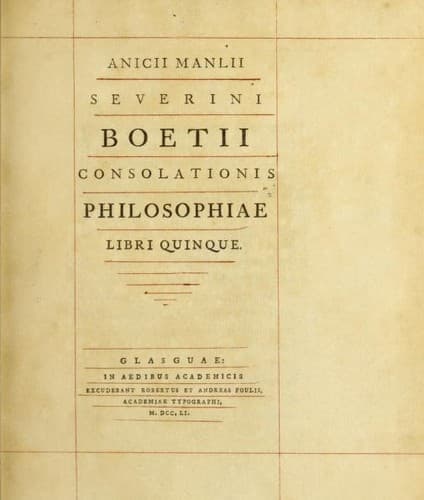
Chaucer's Translation of Boethius's "De Consolatione Philosophiae"Boethius
ReligionComparative
Chaucer's Translation of Boethius's "De Consolatione Philosophiae"
Boethius
Happiness; Philosophy and religion
¶ Thy loor{e} y dempne / it is adu{er}syte
My frend maysthow nat reuen blynde goddesse
Þ{a}t .I. thy frendes knowe .I. thanke to the
Tak hem agayn / lat hem go lye on p{re}sse 52
The negardye in kepynge hyr rychesse
P{re}nostik is thow wolt hir+ towr+ asayle
Wikke appetyt comth ay before sykenesse [[pg 184]]
In general this rewle may nat fayle 56
LE RESPOU{N}CE DE FORTUNE COU{N}TR{E} LE PLEINTIF
¶ Thow pynchest at my mutabylyte
For .I. the lente a drope of my rychesse
And now me lykyth to w{i}t{h}-drawe me
Whi sholdysthow my realte ap{re}sse 60
The see may ebbe {and} flowen moor{e} or lesse
The welkne hath myht to shyne reyne or hayle
Ryht so mot .I. kythen my brutelnesse
In general this rewle may nat fayle 64
LE PLEINTIF
¶ Lo excussyou{n} of the maieste
Þ{a}t al purueyeth of his ryhtwysnesse
That same thinge fortune clepyn ye
Ye blynde beestys ful of lewednesse 68
The heuene hath p{ro}prete of sykyrnesse
This world hath eu{er} resteles trauayle
Thy laste day is ende of myn inter[e]sse
In general this rewele may nat fayle 72
LENUOY DE FORTUNE
¶ Prynses .I. prey yow of yowr{e} gentilesses
Lat nat this man on me thus crye {and} pleyne
And .I. shal quyte yow yowr{e} bysynesse
At my requeste as thre of yow or tweyne 76
Þ{a}t but yow lest releue hym of hys peyne
Preyeth hys best frend of his noblesse
That to som beter{e} estat he may attayne
* * * * *
* * * *
_CHAUCER’S TEXT ONLY_
The following section contains the text alone of Chaucer’s translation
of _De Consolatione Philosophiae_, without the editor’s annotations.
It is followed by the Glossarial Index.
LIBER PRIMUS.
INCIPIT LIBER BOICII DE CO{N}SOLAC{I}O{N}E PHILOSOPHIE.
Car{m}i{n}a qui q{u}onda{m} studio flore{n}te p{er}egi.
[Sidenote: [The fyrste Met{ur}.]]
++Allas I wepyng am constreined to bygynne vers of sorouful matere.
¶ Þat whilom in florysching studie made delitable ditees. For loo
rendyng muses of poetes enditen to me þinges to be writen. and drery
v{er}s of wrecchednes weten my face wiþ v{er}ray teers. ¶ At þe leest no
drede ne myȝt[e] ouer-come þo muses. þat þei ne were{n} felawes {and}
folweden my wey. þat is to seyne when I was exiled. þei þat weren glorie
of my youȝth whilom weleful {and} grene co{n}forten now þe sorouful
werdes of me olde man. for elde is comen vnwarly vpon me hasted by þe
harmes þat I haue. {and} sorou haþ comau{n}ded his age to be in me.
¶ Heeres hore ben schad ouertymelyche vpon myne heued. and þe slak[e]
skyn trembleþ vpon myn emty body. þilk[e] deeþ of men is welful þat ne
comeþ not in ȝeres þat ben swete (.i. mirie.) but comeþ to wrecches
often yclepid.
Public-domain text, read in full here on John Shaqi.
Reviews
Reviews
No reviews yet
Be the first to share your thoughts on this work.
Elsewhere in the archive
Join the Discussion
Join the discussion
Sign in to leave a comment or review.
Sign InorCreate an account