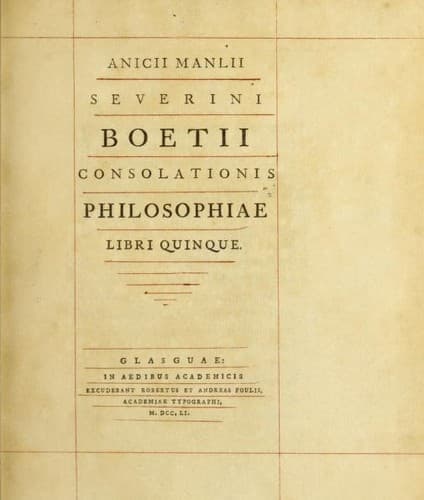
Chaucer's Translation of Boethius's "De Consolatione Philosophiae"Boethius
ReligionComparative
Chaucer's Translation of Boethius's "De Consolatione Philosophiae"
Boethius
Happiness; Philosophy and religion
¶ Is nat þis þe gerdou{n} þat I refere to þe to whom I haue be
obeisaunt. ¶ Certis þou enfo{ur}medist by þe mouþe of plato þis
sentence. þat is to seyne þat co{m}mune þinges or comunabletes weren
blysful yif þei þat haden studied al fully to wisdom gouerneden þilke
þinges. or ellys yif it so by-felle þat þe gouernours of co{m}munalites
studieden in grete wisdomes. ¶ Þou saidest eke by þe mouþe of þe same
plato þat it was a necessarie cause wyse men to taken {and} desire þe
gou{er}nau{n}ce of comune þi{n}ges. for þat þe gou{er}nementes of comune
citees y-left in þe hondes of felonous to{ur}mento{ur}s Citiȝenis ne
scholde not brynge inne pestile{n}ce {and} destrucc{i}ou{n} to goode
folk. ¶ And þerfore I folowynge þilk auctoritee (.s. platonis). desiryng
to put[te] furþe in execusiou{n} {and} in acte of comune
admi{ni}st{ra}c{i}ou{n} þo þinges þat .I. hadde lerned of þe among my
secre restyng whiles. ¶ Þou {and} god þ{a}t put[te] þee in þe þouȝtis of
wise folk ben knowen wiþ me þat no þing brouȝt[e] me to maistrie or
dignite: but þe comune studie of al goodenes. ¶ And þer-of comeþ it þat
by-twixen wikked folk {and} me han ben greuouse discordes. þat ne myȝten
not be relesed by p{ra}yeres. ¶ For þis libertee haþ fredom of
conscience þat þe wraþþe of more myȝty folk haþ alwey ben despised of me
for saluac{i}ou{n} of ryȝt. ¶ How ofte haue .I. resisted {and} wiþstonde
þilk man þat hyȝt[e] conigaste þat made alwey assautes aȝeins þe
p{ro}pre fortunes of poure feble folke. ¶ How ofte haue .I. ȝitte put
of. or cast out hy{m} trigwille p{ro}uost of þe kynges hous boþe of þe
wronges þat he hadde bygon[ne] to done {and} eke fully p{er}formed.
¶ How ofte haue I couered {and} defended by þe auctorite of me put
aȝeins p{er}ils. þat is to seine put myne auctorite in peril for þe
wreched pore folke. þat þe couetise of straungeres vnpunysched
to{ur}mentid alwey wiþ myseses {and} greuaunces oute of noumbre. ¶ Neuer
man drow me ȝitte fro ryȝt to wro{n}g. When I say þe fortunes {and} þe
rychesse of þe people of þe p{ro}uinces ben harmed eyþer by p{r}iue
rauynes or by comune tributis or cariages. as sory was I as þei þat
suffred[e] þe harme. _Glosa._ ¶ Whan þat theodoric þe kyng of gothes in
a dere ȝere hadde hys gerners ful of corne {and} comaundede þat no ma{n}
ne schold[e] bie no corne til his corne were solde {and} þat at a dere
greuous pris. ¶ But I w{i}t{h}stod þat ordinaunce {and} ouer-com it
knowy{n}g al þis þe kyng hym self. ¶ Coempciou{n} þat is to seyn comune
achat or bying to-gidere þat were establissed vpon poeple by swiche a
manere imposiciou{n} as who so bouȝt[e] a busshel corn he most[e] ȝeue
þe ky{n}g þe fifte p{ar}t. _Textus._ ¶ Whan it was in þe soure hungry
tyme þere was establissed or cried greuous {and} inplitable coempciou{n}
þat men seyn wel it schulde greetly to{ur}me{n}tyn {and} endamagen al þe
p{ro}uince of co{m}paigne I took strif aȝeins þe p{ro}uost of þe
pretorie for comune p{ro}fit. ¶ And þe kyng knowyng of it I ouercom it
Public-domain text, read in full here on John Shaqi.
Reviews
Reviews
No reviews yet
Be the first to share your thoughts on this work.
Elsewhere in the archive
Join the Discussion
Join the discussion
Sign in to leave a comment or review.
Sign InorCreate an account