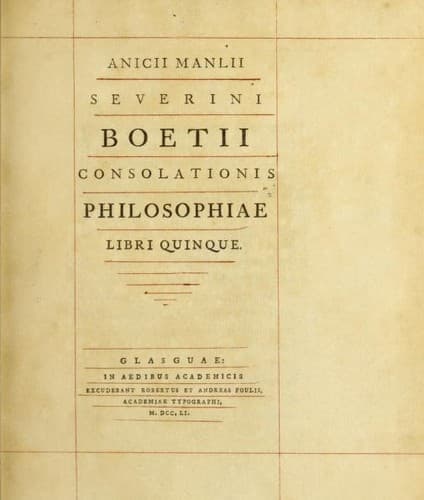
Chaucer's Translation of Boethius's "De Consolatione Philosophiae"Boethius
ReligionComparative
Chaucer's Translation of Boethius's "De Consolatione Philosophiae"
Boethius
Happiness; Philosophy and religion
so þat þe coempciou{n} ne was not axed ne took effect. ¶ Paulyn a
counseiller of Rome þe rychesse of þe whyche paulyn þe houndys of þe
palays. þat is to seyn þe officeres wolde han deuoured by hope {and}
couetise ¶ Ȝit drow I hym out of þe Iowes .s. faucib{us} of hem þat
gapede{n}. ¶ And for as myche as þe peyne of þe accusac{i}ou{n} aiuged
byforn ne scholde not sodeynly henten ne punischen wrongfuly Albyn a
counseiller of Rome. I put[te] me aȝenis þe hates {and}
indignac{i}ou{n}s of þe accuso{ur} Ciprian. ¶ Is it not þan ynought
yseyn þat I haue p{ur}chased greet[e] discordes aȝeins my self. but I
aughte be more asseured aȝenis alle oþer folk þat for þe loue of
ryȝtwisnesse .I. ne reserued[e] neuer no þing to my self to hem ward of
þe kynges halle .s. officers. by þe whiche I were þe more syker. ¶ But
þoruȝ þe same accuso{ur}s accusyng I am co{n}dempned. ¶ Of þe noumbre of
whiche accuso{ur}s one basilius þat somtyme was chased out of þe kynges
seruice. is now co{m}pelled i{n} accusyng of my name for nede of foreine
moneye. ¶ Also opilion {and} Gaudenci{us} han accused me. al be it so
þat þe Iustice regal hadde su{m}tyme demed hem boþe to go in to exil.
for her treccheries {and} fraudes wiþ-outen noumbre. ¶ To whiche
iugement þei wolde not obeye. but defended[e] hem by sykernesse of holy
houses. þat is to seyne fledden in to seyntuaries. {and} whan þis was
ap{er}ceiued to þe kyng. he comaunded[e] but þat þei voided[e] þe citee
of Rauenne by certeyne day assigned þat men scholde merken hem on þe
forheued wiþ an hoke of iren {and} chasen hem out of toune. ¶ Now what
þing semeþ þe myȝt[e] be lykned to þis cruelte. For certys þilk same day
was receyued þe accusyng of my name by þilk[e] same accuso{ur}s. ¶ What
may be seid herto. haþ my studie {and} my konnyng deserued þus. or ellys
þe forseide dampnaciou{n} of me. made þat hem ryȝtful accuso{ur}s or no
(q.d. no{n}). ¶ Was not fortune asshamed of þis. [Certes alle hadde nat
fortune ben asshamyd] þat i{n}nocence was accused. ȝit auȝt[e] sche haue
had schame of þe filþe of myn accuso{ur}s. ¶ But axest þou in so{m}me of
what gilt .I. am accused. men seyne þat I wolde sauen þe co{m}paignie of
þe senato{ur}s. ¶ And desirest þou to here in what manere .I. am accused
þat I scholde han distourbed þe accuso{ur} to beren l{ett}res. by whiche
he scholde han maked þe senatours gilty aȝeins þe kynges Real maieste.
¶ O meistresse what demest þou of þis. schal .I. forsake þis blame þat I
ne be no schame to þe (q. d. no{n}). ¶ Certis .I. haue wold it. þat is
to seyne þe sauuaciou{n} of þe senat. ne I schal neuer leten to wilne
it. {and} þat I confesse {and} am a-knowe. but þe entent of þe accusour
to be destourbed schal cese. ¶ For schal I clepe it a felonie þan or a
synne þat I haue desired þe sauuaciou{n} of þe ordre of þe senat. and
certys ȝit hadde þilk same senat don by me þoruȝ her decretȝ {and} hire
iugementys as þouȝ it were a synne or a felonie þat is to seyne to wilne
Public-domain text, read in full here on John Shaqi.
Reviews
Reviews
No reviews yet
Be the first to share your thoughts on this work.
Elsewhere in the archive
Join the Discussion
Join the discussion
Sign in to leave a comment or review.
Sign InorCreate an account