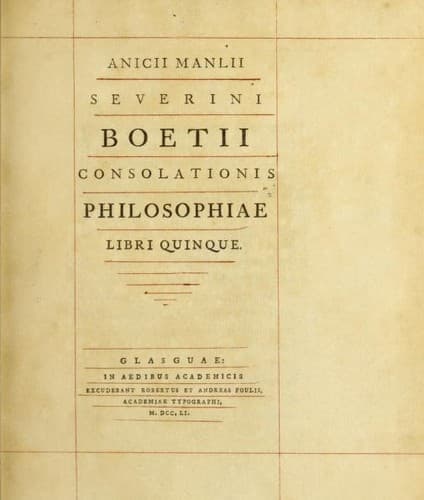
Chaucer's Translation of Boethius's "De Consolatione Philosophiae"Boethius
ReligionComparative
Chaucer's Translation of Boethius's "De Consolatione Philosophiae"
Boethius
Happiness; Philosophy and religion
þe sauuaciou{n} of he{m} (.s senat{us}). ¶ But folye þat lieth alwey to
hym self may not chaunge þe merit of þinges. ¶ Ne .I. trowe not by þe
iugement of socrates þ{a}t it were leueful to me to hide þe soþe. ne
assent[e] to lesynges. ¶ But certys how so euer it be of þis I put[te]
it to gessen or p{re}ise{n} to þe iugeme{n}t of þe {and} of wise folk.
¶ Of whiche þing al þe ordinaunce {and} þe soþe for as moche as folk þat
ben to comen aftir our{e} dayes scholle{n} knowen it. ¶ I haue put it in
scripture {and} remembraunce. for touching þe l{ett}res falsly maked. by
whiche l{ett}res I am accused to han hooped þe fredom of Rome. What
app{er}teneþ me to speken þer-of. Of whiche l{ett}res þe fraude hadde
ben schewed ap{er}tly if I hadde had libertee forto han vsed {and} ben
at þe co{n}fessiou{n} of myn accuso{ur}s. ¶ Þe whiche þing in alle nedys
haþ grete strenkeþ. ¶ For what oþ{er} fredo{m} may men hopen. Certys I
wolde þat some oþ{er} fredom myȝt[e] be hoped. ¶ I wolde þan haue
answered by þe wordes of a man þat hyȝt[e] Canius. for whan he was
accused by Gayus Cesar Germeins son þat he (cani{us}) was knowyng {and}
consentyng of a coniurac{i}ou{n} maked aȝeins hym (.s. Gai{us}). ¶ Þis
Canius answered[e] þus. ¶ Yif I had[de] wist it þou haddest not wist it.
In whiche þing sorwe haþ not so dulled my witte þ{a}t I pleyne oonly þat
schrewed[e] folk apparailen folies aȝeins vertues. ¶ But I wondre gretly
how þat þei may p{er}forme þinges þat þei had[de] hoped forto done. For
why. to wylne schrewednesse þat comeþ p{ar}auenture of oure defaute.
¶ But it is lyke to a monstre {and} a meruaille. ¶ How þat in þe
p{re}se{n}t syȝt of god may ben acheued {and} p{er}formed swiche þinges.
as euery felonous man haþ conceyued in hys þouȝt aȝeins i{n}nocent.
¶ For whiche þing oon of þi familers not vnskilfully axed þus. ¶ Ȝif god
is. whennes comen wikked[e] þinges. {and} yif god ne is whennes comen
goode þinges. but al hadde it ben leueful þat felonous folk þat now
desiren þe bloode {and} þe deeþ of alle goode men. {and} eke of al þe
senat han wilned to gone destroien me. whom þei han seyn alwey
bataile{n} {and} defenden goode men {and} eke al þe senat. Ȝit hadde I
not desserued of þe fadres. þat is to seyne of þe senatours þat þei
scholde wilne my destrucc{i}ou{n}. ¶ Þou remembrest wele as I gesse þat
whan I wolde don or seyn any þing. þou þi self alwey p{re}sent
reweledest me. ¶ At þe citee of verone wha{n} þat þe kyng gredy of
comune slauȝter. caste hym to t{ra}nsporten vpon al þe ordre of þe
senat. þe gilt of his real maieste of þe whiche gilt þat albyn was
accused. wiþ how grete sykernesse of p{er}il to me defended[e] I al þe
senat. ¶ Þou wost wel þat I seide soþe. ne I auaunted[e] me neuer in
preysyng of my self. ¶ For alwey when any wyȝt resceiueþ p{re}ciouse
renou{n} in auauntyng hym self of hys werkes: he amenusiþ þe secre of
hys conscience. ¶ But now þou mayst wel seen to what ende I am comen for
myne i{n}nocence.
Public-domain text, read in full here on John Shaqi.
Reviews
Reviews
No reviews yet
Be the first to share your thoughts on this work.
Elsewhere in the archive
Join the Discussion
Join the discussion
Sign in to leave a comment or review.
Sign InorCreate an account