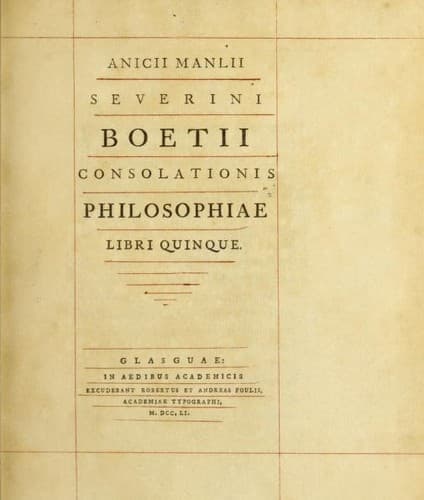
Chaucer's Translation of Boethius's "De Consolatione Philosophiae"Boethius
ReligionComparative
Chaucer's Translation of Boethius's "De Consolatione Philosophiae"
Boethius
Happiness; Philosophy and religion
++FIrst wolt þou suffre me to touche {and} assaie þe stat of þi þouȝt by
a fewe demaundes. so þat I may vnderstonde what be þe manere of þi
curac{i}ou{n}. ¶ Axe me q{uod} .I. atte þi wille what þou wilt. {and} I
schal answer{e}. ¶ Þo saide sche þus. wheþer wenest þou q{uo}d sche
þ{a}t þis worlde be gouerned by foolisshe happes {and} fortunes. or
elles wenest þou þat þer be i{n} it any gouerneme{n}t of resou{n}.
Certes q{uod} .I. ne trowe not in no manere þat so certeyne þinges
scholde be moeued by fortunouse fortune. but I wot wel þat god maker
{and} mayster is gouerno{ur} of þis werk. Ne neuer nas ȝit day þat
myȝt[e] putte me oute of þe soþenesse of þat sentence. ¶ So is it q{uod}
sche. for þe same þing songe þou a lytel here byforne {and} byweyledest
{and} byweptest. þat only men weren put oute of þe cure of god. ¶ For of
alle oþer þinges þou ne doutest nat þat þei nere gouerned by reso{n}.
but how (.i. pape.). I wondre gretly certes whi þat þou art seek. siþen
þou art put in to so holesom a sentence. but lat vs seken depper.
I coniecte þat þere lakkeþ I not what. but sey me þis. siþen þat þou ne
doutest nat þ{a}t þis worlde be gouerned by god ¶ wiþ swycche
gouernailes takest þou hede þat it is gouerned. ¶ vnneþ q{uod} .I. knowe
.I. þe sente{n}ce of þi q{ue}stiou{n}. so þat I ne may nat ȝit answeren
to þi demaundes. ¶ I nas nat deceiued q{uod} sche þat þere ne faileþ
su{m}what. by whiche þe maladie of p{er}turbac{i}ou{n} is crept in to þi
þouȝt. so as þe strengþe of þe paleys schynyng is open. ¶ But seye me
þis reme{m}brest þou ouȝt what is þe ende of þi þinges. whider þat þe
entenc{i}ou{n} of al kynde tendeþ. ¶ I haue herd told it somtyme q{uod}
.I. but drerynesse haþ dulled my memorie. ¶ Certys q{uod} sche þou wost
wel whe{n}nes þat alle þinges ben comen {and} p{ro}ceded. I wot wel
q{uod} .I. {and} ansewered[e] þat god is þe bygynnyng of al. ¶ And how
may þis be q{uod} sche þat siþen þ{o}u knowest þe bygynnyng of þinges.
þat þou ne knowest not what is þe endyng of þinges. but swiche ben þe
customes of p{er}turbac{i}ou{n}s. {and} þis power þei han. þat þei may
moeue a ma{n} fro hys place. þat is to seyne from þe stablenes {and}
p{er}fecc{i}ou{n} of hys knowyng. but certys þei may not al arace hym ne
alyene hy{m} in al. ¶ But I wolde þat þou woldest answere to þis.
¶ Remembrest þou þat þou art a man ¶ _Boice._ ¶ Whi scholde I nat
remembre þat q{uod} .I. _Philosophie._ ¶ Maiste þou not telle me þan
q{uod} sche what þing is a man. ¶ Axest not me q{uod} I. wheþir þat be a
resonable best mortel. I wot wel {and} I confesse wel þat I am it.
¶ Wistest þou neuer ȝit þat þou were ony oþer þing q{uod} she. No q{uod}
.I. now wot I q{uod} she oþer cause of þi maladie {and} þat ryȝt grete
¶ Þou hast left forto knowe þi self what þou art. þoruȝ whiche I haue
pleynelyche knowen þe cause of þi maladie. or ellis þe entre of
recoueryng of þin hele. ¶ Forwhy for þou art co{n}founded wiþ forȝetyng
of þi self.
Public-domain text, read in full here on John Shaqi.
Reviews
Reviews
No reviews yet
Be the first to share your thoughts on this work.
Elsewhere in the archive
Join the Discussion
Join the discussion
Sign in to leave a comment or review.
Sign InorCreate an account